


Introduction
Review Methodology
Theoretical Concept of Flux Chamber
1. Static flux chamber method
2. Dynamic Flux Chamber
3. Passive diffusion flux chamber
Alternative Methods
1. Integrated horizontal flux
2. Tunnel methods
3. Micrometeorological Mass Balance Technique
Emission rates of greenhouse gas (GHG) from composting
Principles, applications, and factors consider in flux chamber method
1. Flux chamber design and configuration
2.Recovery efficiency and flow rate of flux chamber
3. Environmental Conditions
4. Sampling Framework
Conclusions and futures aspects
Introduction
Greenhouse gases (GHGs) play a dual role by regulating Earth’s temperature under normal conditions, yet their excessive accumulation intensifies global warming and climate change (Raga Mexico et al., 2007; Kweku et al., 2018; Ding et al., 2016)). Major GHGs including CO2, CH4, N2O, and various fluorinated gases, have been classified into six primary categories by UNEP (1989). Though emitted in relatively small volumes, synthetic fluorinated gases possess significantly higher global warming potentials compared to other gases (Anderson et al., 2016). Composting releases CO2, CH4, and N2O (Yasmin et al., 2022), but it reduces landfill waste and improves soil fertility (Kent et al., 2019). Accurate emission estimates from manure feedlots remain scarce (Sommer et al., 2004), though studies have used various measurement methods. Composting inevitably produces GHGs and other emissions like NH₃ and H2S, affecting compost quality (Li et al., 2023). Direct methods such as flux chambers are widely applied (Sajeev et al., 2018; Liu et al., 2024), though each has limitations (Mumu et al., 2024).
Flux chambers are portable, affordable, and commonly used for compost piles. They enclose emission sources and measure concentration changes over time. Despite debates on precision (Lindberg et al., 2002; Meisinger et al., 2001), flux chambers remain the primary direct method for composting emissions (Aguerre et al., 2012; Mazzei et al., 2009; Sommer et al., 2004). They help assess spatial heterogeneity in barns or lagoons (Spiehs et al., 2010; Teye & Hautala, 2010; Wheeler et al., 2007). However, limitations in air exchange rates can reduce accuracy (Cole et al., 2007; Pacholski et al., 2006). Proper design, sampling, and analysis are essential for reliable results (Zaman et al., 2021).
Recent advances in flux chamber methodology have significantly improved GHG measurement accuracy. Dankwa et al. (2026) confirmed that flux chambers account for 86.5% of GHG measurement techniques in composting studies, while highlighting the growing role of low-cost automated chambers for continuous monitoring. Comparative studies have demonstrated that static chambers generally underestimate emission rates relative to dynamic hoods, underscoring the need for a unified measurement criterion (Cattaneo et al., 2023). Furthermore, dual-dynamic chamber systems capable of simultaneously measuring reactive nitrogen gases alongside standard GHGs have recently been developed, overcoming the limitation of single-gas measurement approaches (Shah et al., 2026). Therefore, this study aims to review the principles, applicability, and accuracy of flux chamber methods in estimating greenhouse gas emissions from composting piles.
Review Methodology
A wide range of published article research, reviews, books, conference proceedings, and dissertations were gathered from sources such as Scopus, Web of Science, Google Scholar, and ScienceDirect. Both conceptual and practical approaches to flux chambers are considered, including applications in field, pilot, and laboratory settings.
Theoretical Concept of Flux Chamber
Flux chamber methods are widely used to manage and monitor greenhouse gas emissions from composting piles (Yasmin et al., 2022). These techniques are utilized to quantify the flux of various organic compounds from ground sources, such as compost piles and soil (Andersen et al., 2010). However several factors can compromise the accuracy of these measurements. These include the interruption of convective airflow by the chamber structure, the diversion of emissions through permeable compost around the device rather than into it, and the inherent spatial and temporal variability of GHG emissions. Another concern is the possibility of pressure differences between the chamber headspace and the surrounding air, which could lead to either an increase or decrease in GHG fluxes. The accumulation of various greenhouse gases in the chamber headspace poses a challenge, as it can reduce the concentration gradient of gases in the compost, potentially slowing their movement (Denmead, 2008).
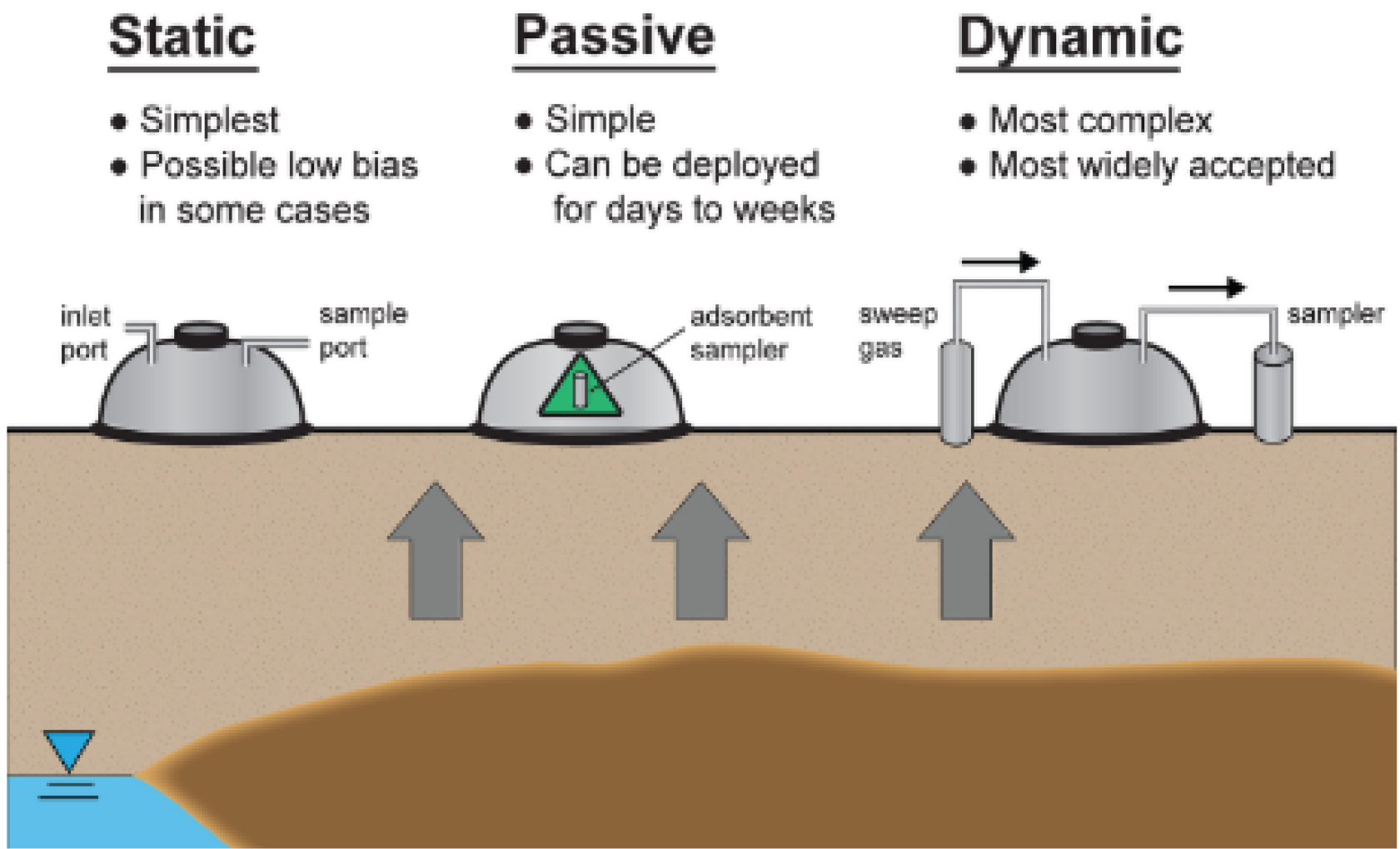
As shown in Figure 1 (Heggie & Stavropoulos, 2018) , flux chamber methods are generally categorized into static, dynamic, and passive diffusion chambers. The static flux chamber is the simplest; however, it may introduce bias under certain conditions. In contrast, the passive diffusion method is simple and can be used over extended periods, from days to weeks. The dynamic flux chamber is more complex and widely accepted. Frechen et al. (2004) further explained that direct measurement methods are typically classified into dynamic, static, and wind tunnel flux chambers.
1. Static flux chamber method
This type of method (static) is one of the traditional methods that can be used to determine gaseous emissions from the ground, such as those from composting and soil. The static flux chamber method is the primary technique used to estimate N2O and CH4 fluxes from compost piles and soil (Yasmin et al., 2022). This method has been verified to be highly valuable and consistent for quantifying CH4 and N2O releases from the field of surfaces (Sommer et al., 2004).
Specifically, Hao et al. (2004) demonstrated its effectiveness in measuring CH4, N2O, and CO2 release during the composting process. A static flux chamber is a closed chamber in absence of air flow (without sweep gas flow), commonly called a “static” or “non-steady-state non-flow-through” chambers (Liu et al., 2024). It does not draw air in and out of the chamber, similar to drawing air in and out of a dynamic flux chamber. Thus, during the incubation period, it’s not necessary to introduce the gas into the chamber (Blayne Hartman, 2003). Static flux chamber in the absence of the movement of gas as a diffusion-driven flux that represents F static is related to time.
Where F_static(t); The gas/substance flux measured using a static flux chamber at time t [e.g., mg·m-2·s-1 or µmol·m-2·s-1], representing the rate of mass transfer per unit area from the composting into the enclosed chamber headspace. V is the internal volume of the flux chamber [m3], i.e., the headspace volume above the surface being measured. A is the surface area enclosed by the chamber [m2]. The ratio V/A [m] is a key geometric property of the chamber design it normalizes the concentration change to a per-unit-area flux. X is A conversion factor accounting for units, temperature, or molecular weight, used to express the flux in the desired units. dC(t)/dt is the rate of change of gas concentration inside the chamber over time (e.g., µmol·m-3·s-1), typically determined from the slope of the concentration-time curve measured during chamber deployment.
The static flux chamber approach may be unsuitable for composting or heat production in different piles of manure, as heating induces airflow outflow from the ground. Therefore, it may underestimate the release from a compost pile (Hellebrand & Kalk, 2000). To prevent gas from escaping, sealing should be performed accurately. To shield the device from atmospheric air forces, the bottom of the chamber was located above the composting litter and placed at a depth of approximately 5-10 cm. This collar features a hole that allows emissions to escape and be drawn into the device/chamber. Proper fastening ensured that no gases escaped. Certain chambers are outfitted with a tube and valve, facilitating the collection of gas samples for extraction within a syringe/needle, which are subsequently transferred into a prepared vacuum, vial, or directly taken through a Tedlar bag. Multiple chambers can be positioned in different areas of the compost pile, covering only an insignificant part of the bed’s surface, typically up to 1m2 (Yasmin et al., 2022). Other studies have also suggested that static chamber anchors should be installed into the soil or composting piles at the study location at least one day before sampling. However, the installation method of the static flux chamber is influenced by the chamber design. Sinking the anchor to a depth of 2.5-13cm, relies on factors such as composting piles or soil, deployment period, and chamber volume (Rochette & Eriksen-Hamel, 2008).
(1) Strengths and Limitations
Static flux chambers are widely used for measuring greenhouse gases from composting piles. They are simple, low-cost, and easy to deploy, allowing simultaneous use across multiple sites and straightforward measurements (Zaman et al., 2021). Their practicality makes them suitable for diverse field conditions. However, static chambers can underestimate fluxes due to gas buildup in the headspace, which reduces diffusion and creates nonlinear fluxes. They also struggle to capture spatial and temporal variability, complicating total emission estimates (Andersen et al., 2010). These issues can be partly mitigated by shorter sampling durations and careful chamber placement (Zaman et al., 2021).
2. Dynamic Flux Chamber
Dynamic flux chambers, often referred to as “dynamic devices” or “flow-through chambers” , providing real-time measurements of gas emissions by continuously exchanging air between the chamber and the external environment. These systems utilize a sweep gas flow and are commonly shaped like flux hoods to ensure well-mixed gas conditions inside (Liu et al., 2024). This method has numerous advantages and principles that boost the accuracy and reliability of gas flux (Park et al., 2014). Maeda et al. (2013) described that this method can be used to measure GHG emissions during the composting of livestock manure, such as dairy manure mixed with orchard grass as a bulking agent. A key characteristic of this method is the continuous introduction of gas into the chamber through an inlet gas (sweep gas), while an equivalent volume of chamber gas is exhausted (Hartman, 2003). Because the dynamic flux chamber uses an in situ automated system with a closed-loop gas flow connected to an infrared gas analyzer, it tends to be more expensive than the static closed chamber (Heinemeyer & McNamara, 2011). Continuous airflow is maintained by drawing air in and out of the chamber, which is common in a dynamic flux chamber but is absent in a static flux chamber (Yasmin et al., 2022). For dynamic flux chamber sweep flush flow of sampling methods the rate of emission, F dynamic (kg/(s⋅m2)), is explained as (Smith et al., 2007).
Where F_dynamic is the gas/substance flux measured using a dynamic (open) flux chamber (e.g., µmol·m-2·s-1 or mg·m-2·h-1), representing the steady-state rate of mass transfer from the surface per unit area. Q is the volumetric flow rate of air purged through the chamber (m3·s-1), i.e., the rate at which carrier air enters and exits the chamber during measurement. C_i is the concentration of the target gas in the air exiting (outlet) the chamber µmol·m-3 or mg·m-3, which is enriched by surface emissions. C_o he concentration of the target gas in the incoming (inlet/background) air the same units as C_i, representing the ambient background level before entering the chamber. C_i - C_o is the concentration difference between outlet and inlet air, reflecting only the gas contributed by the enclosed surface. A is the surface area enclosed by the chamber [m2], used to normalize the flux to a per-unit-area basis.
(1) Strengths and Limitations
Dynamic flux chambers provide real-time monitoring and capture rapid fluctuations in gas release, offering more accurate short-term measurements in variable environments (Mumu et al., 2024; Zaman et al., 2021). They avoid gas accumulation issues common in static systems by continuously flushing the chamber with sweep gas. However, they are more expensive and complex, requiring flow control, real-time analysis equipment, and continuous power, which limits large-scale or remote deployment (Lindberg et al., 2002; Ma et al., 2020; Zaman et al., 2021). Their accuracy also depends on efficient air mixing, precise flow rates, and sensitive analytical methods (Heggie & Stavropoulos, 2018).
3. Passive diffusion flux chamber
A passive diffusion flux chamber is a device that measures gas emissions using a chamber with a headspace containing a carbon-based uptake sampling tube. Contaminated vapors from the underlying surface diffuse into the chamber, where the sampling tube absorbs most of the vapor mass. This method relies on molecular diffusion of gases and does not disturb the composting process (Heggie & Stavropoulos, 2018).
Compared with dynamic flux chambers, the passive diffusion chamber is simpler and can collect gas samples over longer periods, from days to weeks, which helps reduce the influence of short-term variability. However, inserting the absorptive sampling tube may disturb the gas equilibrium between the chamber and the surface, and the tube acts as a reservoir that captures gases until its absorption capacity approaches saturation (Heggie & Stavropoulos, 2018). Despite its advantages, the accuracy of this method depends on the concentration of gases in the chamber. Low gas concentrations can result in low diffusion rates and underestimation of emissions. In addition, environmental factors such as humidity, temperature, and pressure can affect gas diffusion and cause variability in measurements. The passive diffusion flux chamber estimation technique is expressed as follows (Heggie & Stavropoulos, 2018):
In this equation, F (µg/m2·h) represents the flux rate at which a specific contaminant moves into the chamber, M is the mass of the contaminant captured on the tube (measured in µg), A is the area of the chamber surface (in m2), and t is the total sampling period (in h).
(1) Strengths and Limitations
Passive diffusion flux chambers offer a technically simple and cost-effective approach for measuring GHG and volatile organic compound (VOC) emissions, making them particularly suitable for long-term field deployment without requiring external power or airflow control (Dankwa et al., 2026). Unlike static chambers where gas concentrations accumulate over time potentially underestimating flux when headspace concentrations become high enough to reduce the concentration gradient from the source passive chambers use a constant uptake rate passive absorptive sampling tube to measure mass flux, avoiding this limitation (Aumer et al., 2026). However, passive chambers are restricted to diffusive flux measurement only and cannot capture convective or turbulence-driven emissions, which are common in active composting systems (Dankwa et al., 2026). Furthermore, their low spatial coverage may result in underestimation of total emissions from large composting surfaces, and increasing the number of chambers per unit area to compensate is often prohibitively costly in terms of labor and resources.
Alternative Methods
1. Integrated horizontal flux
The Integrated Horizontal Flux (IHF) method is widely considered a benchmark technique for validating new methods used to measure ammonia emissions from fields treated with animal manure and fertilizers. It has also been applied to quantify CH4 and N2O emissions from fertilizer application and liquid manure storage systems. The IHF method estimates vertical gas flux by measuring horizontal gas flows at the upwind and downwind boundaries of the emission source. This technique is robust and does not require additional chemical or physical assumptions for estimating fluxes. Therefore, it is suitable for measuring emissions from spatially heterogeneous and non-planar sources such as composting manure piles. The method has demonstrated a precision of about 20% when measuring ammonium emissions from small slurry storage facilities, indicating a similar level of accuracy (Sommer et al., 2004).
2. Tunnel methods
The tunnel method is employed to estimate greenhouse gas (GHG) emission rates from large sources, such as large-scale manure piles, where conventional chamber methods may be impractical. This method can cover relatively large areas, typically up to about 50 m2, with tunnel dimensions of approximately 10 m length, 5 m width, and 1.5-2 m height (Cardador et al., 2022). In this configuration, fresh air is supplied to the front and both sides of the tunnel, while ventilators induce airflow through the structure from one end to the other. As gases are emitted from the source, they are transported through the tunnel and exit at the rear, where air samples are collected using a 4 mm diameter Teflon tube. The collected gases can then be analyzed using an infrared gas analyzer for gases such as methane and nitrous oxide, or measured in the laboratory using gas chromatography (GC) (Cardador et al., 2022).
3. Micrometeorological Mass Balance Technique
Micrometeorological methods are non-invasive techniques used to measure gas emissions over large areas with high temporal resolution. These methods, including eddy covariance and gradient techniques, are effectively applied to quantify emissions from large-scle composting systems and are often used to validate or adjust flux estimates obtained from traditional chamber measurements (Sommer et al., 2004). By combining meteorological data with gas flux measurements, micrometeorological mass balance approaches provide valuable insights into the dynamics of gas exchange in the environment. They can be used to estimate emissions of methane (CH4), nitrous oxide (N2O), and carbon dioxide (CO2) from composting windrows (Kent et al., 2019).
Emission rates of greenhouse gas (GHG) from composting
Gas emissions arising from the composting of organic waste affect both climate change and air quality. While composting is a biological process that helps mitigate climate change by reducing overall landfill emissions, it simultaneously releases various gases such as CH4, CO2, N2O, NH3, and VOC (Yasmin et al., 2022). In this regard, quantifying or estimating the rate of these various gases from composting is a complex undertaking. Numerous types of research have been done to estimate the emission rates of various gases from composting process, particularly greenhouse gases (GHG), utilizing diverse flux chambers (Ahn et al., 2011; Shan et al., 2019). However, the diverse characteristics of emitting surfaces hinder the quantification of these emissions (Park et al., 2014). It may be affected by a variety of issues, including the specific measurement devices employed, environmental conditions, types of composting substrates, and overall management systems (Table 1).
Table 1.
Greenhouse gas (GHG) emission rates from composting piles measured using different flux chamber techniques.
| Methods and materials | Duration | key conditions |
Emissions (CH4/ CO2 / N2O / NH3) | Remark | References | |
|
Static flux Chamber pig manure | 60 days |
pH7.1-7.5; MC60-65%; Temp 29-37°C |
total GHG: 67.93 g CO2-eq kg-1 DW, 4.56 g NH3 kg-1 DW | NH3 & N2O high early; CH4 later | SHAN et al., 2019 | |
| Flux chamber | Mixed dairy manure | 80 days | H2O 46%; VS 41%; TN 10%; TC 40% | 2.0 kg CO2-eq kg-1 VS | 75% CO2 & 95% CH4 in first 23 days; static piles ~20% more GHG | Ahn et al., 2011 |
| Static dairy manure | 80 days | H2O 41%; VS 44%; TN 8%; TC 45% | 1.6kg CO2-eq kg-1 VS | |||
|
Large flux chamber Dairy manure | 42 days |
CO2: 24.3-31.6 g C m-2 day-1; N2O: 0.17 g N m-2 day-1; CH4: 0.47-1.57 g C m-2 day-1. | Turning vs static piles similar when standardized | Mulbry & Ahn, 2014 | ||
|
Static flux chamber garden waste | 10-14 mo | Temp >50°C most of period | 9.5g h-1m-2/121g h-1 m-2/ 0.33gh-1m-2/ - | Static chambers may underestimate carbon vs dynamic plume | Andersen et al., 2010 | |
|
Small flux chamber Swine manure | 33 days |
Temp 45-48°C; pH 8.2; C/N 24.7; TC 44% |
23-326µgm-2 s-1/ 0.3-2.5 µg m-2 s-1/ - / - | Chamber positioning influenced flux due to heterogeneity. | Park et al., 2014 | |
|
Dynamic flux Cattle Manure | 30 days | Thermophilic temperature |
2.235 kg/head·yr/- / 0.098 kg/head·yr / - | Higher CH4 & N2O under thermophilic conditions | Won et al., 2020 | |
Principles, applications, and factors consider in flux chamber method
No single method is ideal for measuring greenhouse gas (GHG) fluxes because each technique has specific strengths and limitations, and methods suitable for one gas may not be appropriate for gas mixtures (Zaman et al., 2021. Among available techniques, flux chambers are widely used for measuring GHG emissions from composting systems and soil surfaces (Yasmin et al., 2022). The fundamental principle of the flux chamber method involves isolating a small portion of the emitting surface to quantify the gases released into the enclosed headspace (Frechen et al., 2004). This approach has been widely applied to quantify emissions from livestock manure composting piles under various conditions (Sommer et al., 2004). However, the accuracy of flux chamber measurements depends on proper chamber design, experimental conditions, and environmental factors influencing gas emissions.
1. Flux chamber design and configuration
Researchers have developed diverse types of flux chamber configurations, primarily static and dynamic systems, to quantity gas emissions across various substrates (Heggie & Stavropoulos, 2018; Zaman et al., 2021). These chambers are constructed from a range of materials including aluminum, stainless steel, glass, polyethylene, polycarbonate, PVC, and methyl methacrylate, and they vary in shape, size, and volume (Zaman et al., 2021). In a typical static flux chamber setup, gas concentrations gradually increase within the enclosed chamber placed over a portion of the composting surface (Yasmin et al., 2022). However, the progressive accumulation of gases inside the chamber can diminish the concentration gradient, potentially leading to an underestimation of actual emissions.
Chamber size also influences emission measurements. Large flux chambers can cover a greater surface area and better capture spatial variability in compost piles. For example, Ahn et al. (2011) developed a large chamber (1.9 m height and 2.1 m2 area) to measure emissions from entire compost piles. Studies suggest that large chambers provide more accurate estimates than small chambers because they reduce errors caused by spatial variability (Park et al., 2014). Small chambers may underestimate some emissions, such as N2O, because they do not capture variations across the compost surface.
2.Recovery efficiency and flow rate of flux chamber
Recovery efficiency is defined as to the ability of a flux chamber to capture and measure gases emitted from the surface, expressed as the ratio of collected gas to the actual surface gas flux (Zaman et al., 2021). Prior research indicates that recovery efficiencies typically range from 14-75%, depending on chamber design, surface conditions, and sampling methods (Estellés et al., 2010). Some studies reported recovery approaching 100% within 50-100 minutes under controlled conditions (Jeong, 2022) as presented in Table 2. The flow rate represents the volume of air moving through the chamber per unit time (usually L/min) and is a key operational parameter. High flow rates may increase turbulence and reduce measurement accuracy, while inconsistent airflow can affect precision. Therefore, appropriate and standardized flow rates are necessary to ensure reliable gas sampling and comparable results across studies (Estellés et al., 2010).
Table 2.
Recovery efficiency, chamber and airflow parameters of static and dynamic flux chambers used for gas emission measurements.
| Chamber type | Chamber Size (m3) | Recovery Eff. (%) | Air flow rate L/min | Gas | Quantitative result | Interpretation | Applicability | Limitation | References |
| Dynamic FC | 0.03 | NR | 1-5 | VOC | VOC emissions increased as sweep gas flowincreased | Higher airflow likely enhanced turbulence and gas transport, increasing measured VOC release | Useful for controlled VOC chamber studies | Recovery efficiency not reported | (Liu et al., 2024) |
| Dynamic FC | 0.032 | 100 | 5 | CH4 | Complete CH4 recovery under tested condition | Very strong chamber performance for CH4 under this specific operating condition | Suitable for calibration / controlled recovery studies | Only one operating condition reported | (Jeong, 2022) |
| Dynamic FC | 0.1705 | NR | 1-5 | GHG & NH3 | Airflow should match manure emission strength for better measurement | Chamber performance depends on matching flow to source strength |
Useful for variable manure/ compost emissions |
Recovery /error not numerically reported | (Estellés F. et al., 2010) |
| Dynamic FC | 0.0159 | 99 |
2-5 - | H2S | Higher airflow diluted H2S concentration, despite high recovery | Good recovery does not always mean high measured concentration; dilution matters |
Useful for reduced- sulfur gas monitoring | High airflow may underestimate concentration by dilution | (Andreão et al., 2019) |
| Dynamic FC | 0.0038 | 97.3 |
2 - | GHG & NH3 | Accuracy reached about 97% of calibration value | Small chambers can be analytically accurate under controlled conditions | Good for laboratory validation | Small chamber may have limited field representativeness |
(Wheeler et al., 2011) |
| Dynamic hood vs static hood | 0.12 | NR | 0.2-0.3 | NH3, N2O, CO2, CH4 | Dynamic hoods produced comparable rates to each other, and rates were always higher than static hood values | Static hood likely underestimates emissions relative to dynamic systems | Very useful for methodological comparison | Not compost-only; includes several manure by-products | (Cattaneo et al., 2023) |
| Small chambers vs mega chamber | 0.72 | NR | - | N2O, CH4 | Small chambers produced CH4 values similar to or 1.4× higher than mega chamber, but N2O was 50-55% lower | Chamber size strongly affects spatial representativeness, especially for N2O hot spots | Highly relevant to composting reviews | Older study, but still very important methodologically | (Park et al., 2014) |
3. Environmental Conditions
Environmental conditions exert a profound influence on greenhouse gas emissions during the composting process. Temperature affects microbial activity and gas production; higher temperatures (around 40-50°C) can increase methane (CH4) and ammonia emissions, while nitrous oxide (N2O) emissions tend to occur when temperatures drop below 40°C (Yasmin et al., 2022). Compost piles often have the highest temperatures in the core, which can enhance CH4 production while simultaneously limiting N2O formation (Park et al., 2014). Furthermore, aeration and moisture content also play important roles. Adequate aeration reduces methane emissions by improving oxygen availability, whereas poor aeration or high moisture levels (>60%) can promote anaerobic conditions and increase CH4 and N2O emissions (Scaglia et al., 2011). In addition, the use of additives, such as reed straw, can improve oxygen conditions in compost and help reduce greenhouse gas emissions (Park et al., 2014). Static chambers overestimated flux by 20-35% compared to dynamic chambers at temperatures above 40°C (Shah et al., 2026), likely because high temperatures accelerate gas accumulation in the closed headspace.
4. Sampling Framework
Comprehensive monitoring, evaluation, and strategic planning are usually required before collecting gas samples to allow conditions inside the chamber to reach equilibrium and ensure accurate measurements (Liu et al., 2024).
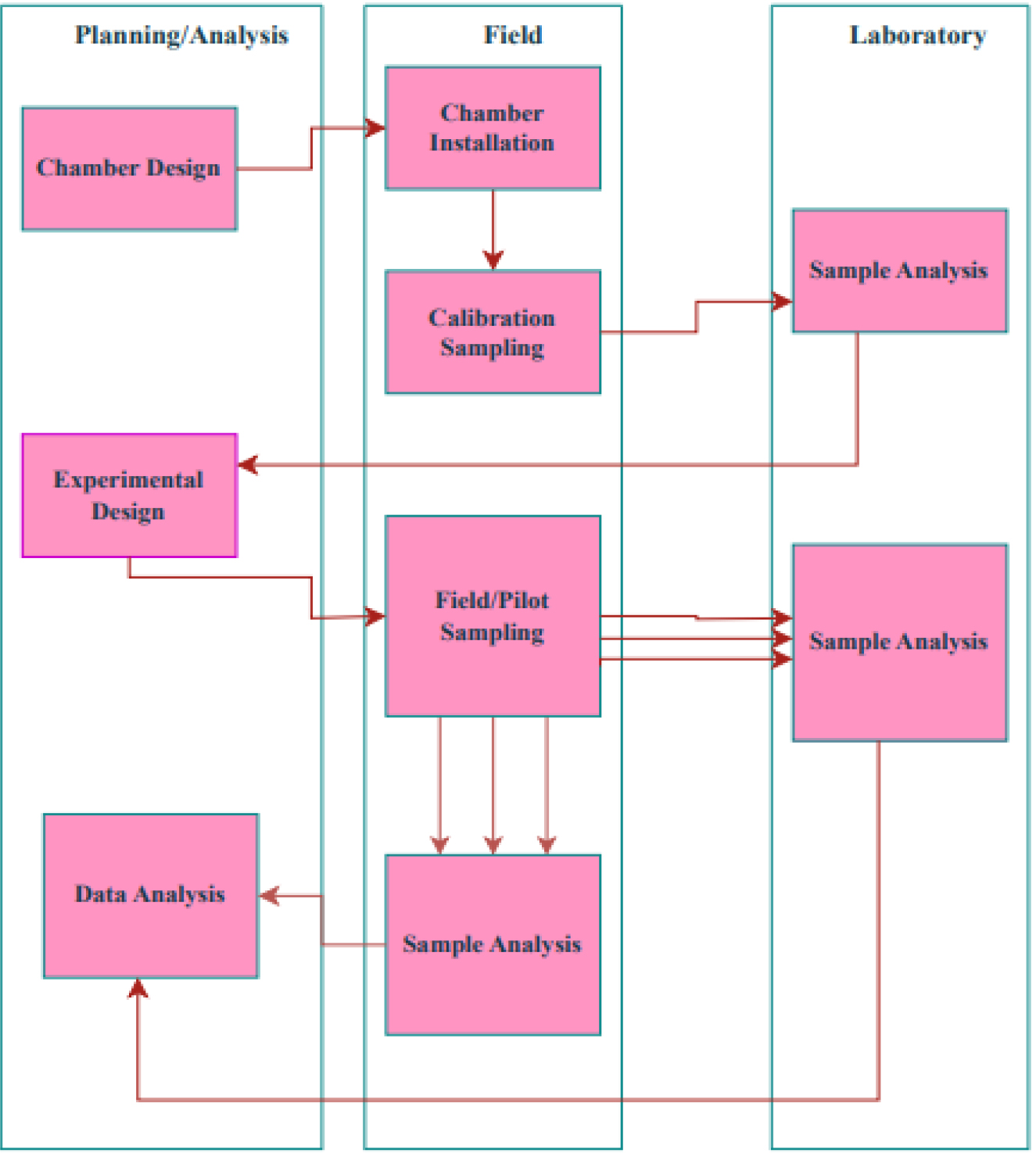
Figure 2 shows the main steps of the sampling design, from flux chamber design/selection to data analysis, covering the planning, pilot/field, laboratory, and composting stages. The arrows indicate the workflow, and multiple arrows between field sampling and sample analysis represent repeated data collection during the experiment. In some cases, data may also be analyzed directly in the field to improve accuracy. The workflow should include instrument calibration, chamber sensitivity testing, and proper sampling duration and frequency, especially during key composting activities such as pile turning. In addition, standardized flux chamber methods should use safe testing media, widely accepted procedures, common laboratory equipment, accessible sweep air, and allow measurements applicable to both laboratory and field conditions (Rochette & Eriksen-Hamel, 2008).
Conclusions and futures aspects
The flux chamber method is the most widely adopted technique for estimating gas emissions from composting piles, including CO2, CH4, N2O, trace gases, and odors. It is practical, cost-effective, and simple to deploy, making it especially suitable for short-term measurements. However, accuracy is affected by chamber size, gas diffusion, sampling duration, and environmental factors such as moisture, temperature, and wind. While flux chambers provide valuable insights, they often miss spatial and temporal variability, leading to possible under- or overestimations. To enhance reliability, chambers should be calibrated, standardized, and protected from environmental interference, and ideally combined with complementary methods like micrometeorological or eddy covariance techniques. Future improvements should focus on dynamic designs that better replicate real conditions and passive diffusion chambers as alternatives. Used alongside other approaches, flux chambers can provide a more complete understanding of composting emissions and support sustainable waste management practices.