서 론
선행 연구
사육거리제한 지자체 조례 제정 현황
사육거리제한 해외 사례 현황
축산악취 저감 방법
축산악취 저감 시설 및 장비 적용 사례
축산악취 저감 설치 시설·장비 설명
1. 바이오 커튼
2. 안개 분무 시스템
3. 액비순환시스템
4. 습식 세정탑
5. 기타
결 론
서 론
과거 1990년 축산업 생산액이 4조 원에 불과하던 것이 2018년 기준 농촌경제연구원 자료에 따르면 농림업 생산액의 38.3%, 18조9580억 원을 차지하게 됨으로써 대한민국 경제에 영향을 미칠 정도로 급격하게 성장을 하였다. 하지만 과거 우리나라 산업에 대한 정책들이 양적 성장 위주로 추진하다 보니 환경문제에 대해서는 등한시한 경향이 있었다. 그러나 국내 경제 규모의 성장에 따라 삶의 질의 욕구가 증대되고 주거‧생활환경에 대한 중요도가 높아진 현재에는 대다수 국민들은 환경문제에 많은 관심을 가지게 되었다.
위와 같이 국민의 환경에 대한 관심이 증가함에 따라 축산업이 위축되고 있는 것이 현실이다.특히, 축산시설에서 발생되는 악취로 인한 민원은 해가 지날수록 증가하고 있다. 환경부에서 발표한 2014년부터 2016년까지 악취민원 현황을 보면 Table 1과 같이 전체 악취민원은 2014년 14,816건, 2015년 15,573건, 2016년 16,116건으로 매년 3%이상씩 증가하는 것을 볼 수 있다. 그 중에서 축산시설 악취민원의 경우는 2014년 2,838건, 2015년 4,323건, 2016년 6,398건으로 매년 50%이상 증가고 있는 것으로 나타났다.
Table 1.
Civil complaints about odor statistic (2014~2016).
|
Year
|
All civil complaints against odor
|
Odor complaint against
livestock facility
|
Ratio of complaints against livestock
facility among all complaints
|
|
2014
|
14,816
|
2,838
|
19.15
|
|
2015
|
15,573
|
4,323
|
27.76
|
|
2016
|
16,116
|
6,398
|
36.70
|
이런 현실을 반영하듯이 2015년 3월 30일 환경부에서는 「가축분뇨의 관리 및 이용에 관한 법률」 제8조에 의거하여 지자체 사육조례 제·개정 관련 권고안을 Table 2와 같이 발표 하였다. 여기서 가축사육거리제한구역이란 지역주민의 생활환경보전 또는 상수원의 수질보전을 위하여 가축사육의 제한이 필요하다고 인정되는 경우에 시장 · 군수 · 구청장이 「가축분뇨의 관리 및 이용에 관한 법률」및 해당 지방자치단체의 조례가 정하는 바에 따라 지정한 구역을 말하며 지방자치단체의 사육제한구역 거리조례 제정 현황은 Table 3과 같다. 이에 가축사육제한구역으로 지정할 수 있는 대상지역은 다음과 같다. 주거밀집지역으로 생활환경의 보호가 필요한 지역, 「수도법」에 따른 상수원보호구역, 「환경정책기본법」에 따른 특별대책지역 및 그 밖에 이에 준하는 수질환경보전이 필요한 지역, 「한강수계 상수원수질개선 및 주민지원 등에 관한 법률」, 「낙동강수계 물관리 및 주민지원 등에 관한 법률」, 「금강수계 물관리 및 주민지원 등에 관한 법률」, 「영산강·섬진강수계 물관리 및 주민지원 등에 관한 법률」에 따라 지정·고시된 수변구역, 「환경정책기본법」에 따른 환경기준을 초과한 지역, 환경부장관 또는 시·도지사가 가축사육제한구역으로 지정·고시하도록 요청한 지역, 시장·군수·구청장은 가축사육제한구역에서 가축을 사육하는 자에 대하여 축사의 이전 그 밖에 위해의 제거 등 필요한 조치를 명할 수 있으며, 축사의 이전을 명할 때에는 1년 이상의 유예기간을 주어야 하고, 이전에 따른 재정적 지원, 부지알선 등 정당한 보상을 하여야 하는 것으로 되어 있다.
하지만, 지나친 지자체의 사육거리제한으로 인하여 축산업을 신규로 하거나 오래된 축사를 개축하고 싶어도 하지 못하는 경우가 빈번히 발생하게 되었다. 축산업이 경제에 미치는 영향 등을 고려하였을 때 악취를 저감하여 주변에 민원을 발생시키지 않고 축산업을 영위하고자 하는 축산농가에 대해서는 사육제한 거리를 완화해 주어야 할 것으로 판단된다.
다행히도 그런 부분을 반영하여 환경부에서는 Table 2에서와 같이 비고에 동 권고안은 신규 입지하는 시설 및 허가를 받거나 신고한 기존시설의 증·개축을 관리하기 위함, 악취를 저감할 수 있는 있는 시설 설치 및 관리하는 경우 축산 신축 및 증·개축시 거리 제한 완화 가능하다고 하였다.
그럼 우리는 비고 내용이 지자체 권고안에 반영되고 있는지에 대한 현황조사를 통해 지속가능한 축산업이 될 수 있도록 개선되어야 할 방향이 있는지 찾아볼 필요가 있으며 그에 따라 악취저감시설을 설치한 사례에 대한 조사가 필요하다고 사료된다.
Table 2.
|
Type
|
Previous recommendation (m)
|
Current recommendation (m)
|
Note
|
|
beef cattle
|
100
|
less than 400
|
50
|
※ The purpose of this recommendation is for
management of newly installed facility
and authorized pre-existing facility
※ The purpose of this recommendation is for
management of newly installed facility
and authorized pre-existing facility
|
|
more than 400
|
70
|
|
dairy
|
250
|
less than 400
|
75
|
|
more than 400
|
110
|
|
swine
|
500
|
less than 1,000
|
400
|
|
1,000 to 3,000
|
700
|
|
more than 3,000
|
1,000
|
|
poultry
|
500
|
less than 20,000
|
250
|
|
20,000 to 50,000
|
450
|
|
more than 50,000
|
650
|
선행 연구
2015년 가축분뇨 관리 및 이용에 관한 법률의 사육거리제한에 관하여 환경부에서 권고안이 나온 이유로 사육제한 거리에 대한 논의가 시작되었다. 대표적으로 2016년에 유성희는 “가축분뇨법”상 가축분뇨관리제도의 개선방안에 관한 연구에서 주민과 농가간에 이익형량을 통한 과도한 규제를 자제하되, 권고안의 형식이 아닌 법령에서 사육제한 거리에 대한 기준을 제시 필요와 가축분뇨실태조사와 관련하여 시행령과 고시 간의 조화를 이루어야 하며, 가축분뇨의 자원화에 영향을 미치는 항생제의 사용에 관한 기준을 「가축분뇨의 관리 및 이용에 관 한 법률」에서 규정할 수 있도록 법적 정비가 필요하다고 하였으며 2016년 한국오리협회에서는 ‘2011년 10월 환경부에서 각 지자체에 시달한 가축사육조례 개정 권고안에 따른 사육거리제한 기준에 대한 설명 자료를 다루었다. 이처럼 사육제한 거리에 대해서는 최근 들어 이슈화 되었으며 사육거리제한에 대한 이해를 위한 자료가 전부일 것이다. 따라서 본 연구에서는 지자체 조례에 따른 사육거리제한에 대한 현황과 지자체 사육제한 조례 제·개정 권고안에 따른 비고 사항 중 현재 축산농가에 설치 될 수 있는 악취저감시설 설치 사례 및 소개를 통해서 축산업의 신규 및 개축에 대한 애로사항을 해소를 하고 지자체 조례 개정시 참고할 수 있는 설명 자료로 활용되길 기대한다.
Table 3.
Current status on breeding restriction areas distance ordinance of local government (2015).
Metropolitan local
government
|
Local
government
|
With the
ordinance
|
Without the
ordinance
|
Note
|
Sejong Special
Self-Governing (si)
|
1
|
1
| | |
|
Gyeonggi (do)
|
31
|
22
|
9
|
Goyang (si), Gwangmyeong (si), Gwangju (si), Siheung (si), Anyang (si),
Yongin (si), Pyeongtaek (si, 2009)*, Hwaseong (si), Yangpyeong (gun)
|
|
Gangwon (do)
|
18
|
16
|
2
|
Sokcho (si, 2008)*, Pyeongchang (gun)
|
|
Chungcheongbuk (do)
|
11
|
11
| | |
|
Chungcheongnam (do)
|
15
|
14
|
1
|
Taean (gun, 2010)* |
|
Jeollabuk (do)
|
14
|
14
| | |
|
Jeollanam (do)
|
22
|
22
| | |
|
Gyeongsangbuk (do)
|
23
|
23
| | |
|
Gyeongsangnam (do)
|
18
|
15
|
3
|
Geoje (si), Yangsan (si), Tongyeong (si, 2008)* |
Jeju Special
Self-Governing (do)
|
2
|
2
| | |
|
Total
|
155
|
140
|
15
| |
사육거리제한 지자체 조례 제정 현황
최근 환경부와 농림축산식품부가 발표한 보고서에 따르면 가축사육규모가 극히 적은 서울특별시, 부산광역시, 대구광역시, 광주광역시, 대전광역시, 울산광역시를 제외한 154개 기초자치단체 중에서 조례 제정 지자체 수는 140개로 약 90.3%가 제정하여 운영하고 있는 것으로 나타났다.
또한 2017년 농협경제지주 자료 Table 4에 의하면 155개 기초자치단체 중에서 조례 제정 지차체 수는 155개 중 151개로 약 97.4%가 제정하여 운영하는 것으로 2015년 조사된 것에 비하여 7%이상 높아진 것으로 보인다. 이는 전제 155개 기초자치단체 중에서 4개소를 제외한 것으로 전국에 걸쳐 축사사육제한구역이 설정된 것으로 볼 수 있다.
Table 4.
Current status on breeding restriction areas distance ordinance of local government (2017).
Metropolitan government
(province)
|
Local government
(county)
|
With the ordinance
|
Without the ordinance
|
List of the county without
the ordinance
|
Sejong Special
Self-Governing (si)
|
1
|
1
| | |
|
Gyeonggi (do)
|
31
|
29
|
2
|
Gwangmyeong (si), Yangpyeong (gun)
|
|
Gangwon (do)
|
18
|
17
|
1
|
Sokcho (si)
|
|
Chungcheongbuk (do)
|
11
|
11
| | |
|
Chungcheongnam (do)
|
15
|
15
| | |
|
Jeollabuk (do)
|
14
|
14
| | |
|
Jeollanam (do)
|
22
|
22
| | |
|
Gyeongsangbuk (do)
|
23
|
23
| | |
|
Gyeongsangnam (do)
|
18
|
17
|
1
|
Tongyeong (si), (2008)* |
Jeju Special
Self-Governing (do)
|
2
|
2
| | |
|
Total
|
155
|
151
|
4
| |
그리고 Table 5와 같이 전국 지자체 조례의 가축사육제한 평균 거리 제한은 한육우는 최대 거리제한을 1,300 m로 최소 거리제한을 50 m로 하였으며 평균거리는 241 m로 나타났다. 젖소는 최대 거리제한을 1,300 m로 최소 거리제한을 100 m로 하였으며 평균거리는 321 m로 나타났다. 돼지는 최대 거리제한을 2,000 m로 최소 거리제한을 100 m로 하였으며 평균거리는 971 m로 나타났다. 가금류는 최대 거리제한을 2,000 m로 최소 거리제한을 100 m로 하였으며 평균거리는 785 m로 나타났다.
Table 5.
Current status on average breeding restriction areas distance ordinance of local government (unit: m).
|
Distance
|
Beef cattle
|
Dairy cattle
|
Swine
|
Poultry
|
|
Maximum
|
1,300
|
1,300
|
2,000
|
2,000
|
|
Minimum
|
50
|
100
|
100
|
100
|
|
Average
|
241
|
321
|
971
|
785
|
이를 주요 광역자치단체별 가축사육제한 평균 거리제한 현황을 보면 Table 6과 같이 나타나는데 사육두수와 거리제한에 있어서는 큰 차이가 없는 것으로 나타났다.
Table 6.
Current status on average distance of breeding restriction areas distance of metropolitan government.
Metropolitan
government
|
Beef cattle
|
Dairy cattle
|
Swine
|
Poultry
|
Setback
distance (m)
|
Number of
livestock
|
Setback
distance (m)
|
Number of
livestock
|
Setback
distance (m)
|
Number of
livestock
|
Setback
distance (m)
|
Number of
livestock
|
|
Gyeonggi (do)
|
138
|
291,058
|
295
|
165,142
|
773
|
1,991,988
|
573
|
27,754,852
|
|
Gangwon (do)
|
292
|
211,315
|
329
|
18,772
|
633
|
469,296
|
533
|
6,202,038
|
|
Chungcheongbuk (do)
|
259
|
209,727
|
350
|
21,496
|
891
|
632,255
|
700
|
12,302,709
|
|
Chungcheongnam (do)
|
318
|
368,586
|
385
|
68,568
|
1179
|
2,296,569
|
1183
|
28,889,154
|
|
Jeollabuk (do)
|
394
|
357,983
|
479
|
33,860
|
1857
|
1,342,314
|
1025
|
31,415,768
|
|
Jeollanam (do)
|
181
|
475,069
|
262
|
29,651
|
981
|
1,058,361
|
905
|
23,087,410
|
|
Gyeongsangbuk (do)
|
139
|
665,318
|
242
|
4,990
|
606
|
1,434,076
|
553
|
23,658,436
|
|
Gyeongsangnam (do)
|
265
|
295,758
|
294
|
24,860
|
807
|
1,268,876
|
732
|
10,966,486
|
Jeju Special
Self-Governing(do)
|
200
|
36,059
|
200
|
4,295
|
1000
|
548,406
|
1000
|
1,630,375
|
다음으로는 2017년 농협경제지주 지자체별 가축사육제하나 관련 조례 모음집 자료에 의하며 시도에 따른 시군별 지자체별 가축사육 제한 조례는 Table 7에부터 Table 15 까지 이다. 여기서 절대제한지역은 가축의 사육이 생활환경 보전이나 상수원의 수질 보전에 직접적으로 지장을 초래하고 그 정도가 심하다고 판단되는 지역을 말하며, 상대제한지역은 가축의 사육이 생활환경 보전이나 상수원의 수질 보전에 직접 또는 간접적으로 지장을 초래하는 지역을 말하며, 기타제한지역은 가축의 사육이 생활환경 보전이나 상수원의 수질 보전에 직접 또는 간접적으로 지장을 초래할 우려가 있는 지역을 말한다.
Table 7.
Summary of breeding restriction ordinance in Gyeonggi-do (province).
|
Province
|
County
|
Relative restricted areas
|
Relative restricted areas
|
Number
of
livestock
farm
|
Beef
cattle
|
Dairy
cattle
|
Swine
|
Poultry
|
|
Gyeonggi
|
Gapyeong
| | | | | |
-Among urban areas
1)Within residential areas (Class 1, 2 exclusive residential areas,
general residential areas, Class 1, 3 general residential areas)
2)Within commercial areas (central commercial areas, general
commercial areas, neighboring commercial areas, distribution
commercial areas)
3)Within industrial areas (exclusive industrial areas)/-water-source
protection areas
|
|
Gyeonggi
|
Goyang
| | | | | |
-In and around the apartment complex, areas where residential
buildings of 50 or more are concentrated (except rural villages)
and adjacent areas
-Areas where five or more business and commercial buildings are
concentrated and surrounding frequently accessed by an
unspecified
number of people.
|
|
Gyeonggi
|
Gwacheon
| | | | | |
-Jungang-dong (entire areas), Gwanmun-dong (entire areas),
Wonmun-dong (entire areas), Byeolyang-dong (entire areas),
Burim-dong (entire areas), Galhyeon-dong (partial areas),
Gwacheon-dong (partial areas), Juam-dong (partial areas),
and Munwon-dong (partial areas)
|
|
Gyeonggi
|
Gwangju
| | | | | |
-Restriction on entire areas (Songjeong 1-dong, Songjeong 2-dong,
Dosan-dong, Sinheung-dong, Eoryong-dong, Usan-dong,
Wolgok 1-dong,
Wolgok 2-dong, Via-dong, Advanced 1-dong,
Advanced 2-dong,
Singa-dong, Unnam-dong, Sinchang-dong,
Suwan-dong)
-Restriction on residential areas (Hanam-dong,
Imgok-dong,
Donggok-dong, Pyeong-dong)
-Restriction on residential areas and Planned control areas
(Samdo-dong, Bonryang-dong)
|
|
Gyeonggi
|
Guri
| |
100
|
100
|
100
|
100
|
-Galmae-dong (residential), Donggu-dong (residential +
commercial), Inchang-dong (residential + commercial),
Gyomun 1-dong (residential + commercial), Gyomun 2-dong
(residential), Sutae 1-dong (residential + commercial), Sutae
2-dong (residential, commercial), Sutaek 3-dong (residential)
|
|
Gyeonggi
|
Gunpo
| |
200
|
200
|
200
|
200
|
-Entire areas (Geumjeong-dong, Dang-dong, Dangjeong-dong,
Sanbon-dong)
-Residential, commercial, industrial areas and areas within 200 m
from outermost boundary (Daeyami-dong, Domagyo-dong,
Dundae-dong, Bugok-dong, Sokdal-dong)
|
|
Gyeonggi
|
Kim-Po
| | | | | |
-Residential, commercial, or industrial areas among urban areas
|
|
Gyeonggi
|
Namyangju
| | | | | |
-Residential, commercial, or industrial areas among urban areas
|
|
Gyeonggi
|
Dongducheon
|
5
|
300
|
300
|
500
|
500
|
-Urban areas[residential, commercial, industrial, green areas
(include only natural community areas)
-A lineal distance to the boundary of the residential areas with 5 or
more households or to the boundary of the waste-generating facility
(areas within 300 m for beef cattle, horses, sheep, 500 m for swine,
poultry, deer, canine and 1 km for corporate livestock)
-A lineal distance from the boundary of the urban areas to the
waste-generating facility (areas within 300 m for beef cattle, horses,
sheep, 500 m for swine, poultry, deer, canine and 1 km for
corporate livestock)
-Areas within 200 m from water source of local and village
waterworks and small water intake facility and its designated site
-Groundwater conservation zones
|
|
Gyeonggi
|
Bucheon
| | | | | |
-Entire areas (Simgok-dong, Wonmi-dong, Sosa-dong,
Dodang-dong,
Yakdae-dong, Jung-dong, Sang-dong,
Simgokbon-dong, Sosa-bon-dong,
Songnae-dong, Wonjong-dong,
Samjeong-dong, Nae-dong)
-Areas except green areas
|
|
Gyeonggi
|
SeongNam
| | | | | |
-Residential, commercial, or industrial areas among urban areas
|
|
Gyeonggi
|
Suwon
| | | | | |
-Wajang-dong, Imok-dong, Yuljeon-dong, Cheoncheon-dong,
Jeongja-dong, Yeonghwa-dong, Songjuk-dong, Jowon-dong,
Yeonmu-dong, Sanggwanggyo-dong, Hagwanggyo-dong,
Seryu-dong, Pyeong-dong, Tap-dong, Seodun-dong,
Guun-dong, Gwonseon-dong, Maegyo-dong, Gyo-dong,
Buksu-dong, Jangan-dong, Sinpung-dong, Hwaseo-dong,
Maesan-ro 1-ga, Maesan-ro 2-ga-dong, Maesan-ro 3-ga,
Gojeong-dong, Paldal-ro 1-ga, Paldal-ro 2-ga, Paldal-ro 3-ga,
Namchang-dong, Yeongdong, Jung-dong, Gucheon-dong,
Namsu-dong, Maehyang-dong, Ji-dong, Uman-dong,
Ingye-dong, Maetan-dong, Woncheon-dong,
Yeongtong-dong, Iui-dong, Hadong, Mangpo-dong, Shindong
|
|
Gyeonggi
|
Siheung
| | | | | |
-Residential, commercial, or industrial areas among urban areas,
areas within 1 km from reservoir boundary
|
|
Gyeonggi
|
Ansan
| |
100
|
100
|
100
|
100
|
-Ildong, Idong, Sadong, Bono-dong, Wolpi-dong, Wadong,
Seongpo-dong, Gojan-dong, Wongok-dong, Moknae-dong,
Wonwon-dong, Choji-dong, Seonggok-dong.
|
|
Gyeonggi
|
Anseong
|
5
|
1300
|
1300
|
1300
|
1300
|
-Urban areas [residential, commercial, industrial, green areas
(include only natural community areas)]
|
|
Gyeonggi
|
Anyang
| | | | | |
-Anyang 1-dong, Anyang 2-dong, Anyang 3-dong, Anyang 4-dong,
Anyang 5-dong, Anyang 6-dong, Anyang 7-dong, Anyang 9-dong,
Bakdal 1-dong, Bisan 2-dong, Buheung-dong, Dalan-dong,
Burim-dong,
Pyeongchon-dong, Pyeongan-dong, Gwiin-dong,
Hogye 2-dong,
Hogye 3-dong, Beomgye-dong, Sinchon-dong,
Galsan-dong,
Sinchon-dong, Galsan-dong
|
|
Gyeonggi
|
Yangju
| |
100
|
100
|
100
|
100
|
-Urban areas (residential, commercial, industrial, green areas),
water-source
protection areas, areas where collective complaints
continue to occur
|
|
Gyeonggi
|
Yeoju
| |
100
|
200
|
500
|
500
|
-Urban areas (residential, commercial, industrial, green areas)
|
|
Gyeonggi
|
Yeoncheon
|
5
|
200
|
200
|
500
|
500
|
-Urban areas (residential, commercial, industrial, green areas),
in case of enterprise type swine farm is at least 1,000 m
|
|
Gyeonggi
|
Osan
| | | | | |
-Jungang-dong (16 Tong), Daewon-dong (1 Tong, 4 Tong),
Namchon-dong (5 Tong), and Sinjang-dong.
|
|
Gyeonggi
|
Yongin
|
5
|
250
|
250
|
1000
|
650
|
-Urban areas (residential, commercial, industrial)
|
|
Gyeonggi
|
Uiwang
| | | | | |
-Urban areas (residential, commercial, industrial)
|
|
Gyeonggi
|
Uijeongbu
| | | | | |
-Entire areas (Uijeong 1-dong, Uijeongbu 2-dong, Uijeongbu 3-dong,
Ganeung 2-dong)
-Natural green areas, entire areas except productive green areas
(Howon 1-dong, Howon 2-dong, Jangam-dong, Singok 1-dong,
Singok 2-dong, Songsan 1-dong, Songsan 2-dong, Fund-dong,
Possible 1-dong, Possible 3-dong, Nokyang-dong)
|
|
Gyeonggi
|
Icheon
| | | | | |
-Urban areas (residential, commercial, industrial):
Changjeon-dong 1-12, Jungri-dong 1-5,
Gwango-dong 1-6, Janghowon 1-5, Notap 3-ri,
Onam 1-ri
-Areas within clearance zoness of national expressways
and highways (industrial), main local highways, entire
areas of Dongyang Beer Co., Ltd.’s Icheon plant site
|
|
Gyeonggi
|
Paju
| | | | | |
-Residential areas
|
|
Gyeonggi
|
Pyeong
taek
|
5
|
100
|
250
|
500
|
500
|
-Residential areas, commercial areas, industrial areas, regions
subject
to the total pollution load control, school environmental
sanitation
and cleanup zones, water-source protection areas, areas
that does over
environmental standards, special-measures areas,
tourist complex,
designated special tourist zones, areas within 200 m
from water
source of local and village waterworks and small water
intake facility
and its designated site
|
|
Gyeonggi
|
Pocheon
| | | | | |
-Water-source protection areas, Framework Act On Environmental
Policy (special-measures areas, areas that does over environmental
standards), urban areas, school environmental sanitation and
cleanup
zones, tourist destinations
|
|
Gyeonggi
|
Hanam
|
5
|
250
|
250
|
1000
|
650
|
-Residential, commercial, or industrial areas among urban areas,
areas within 300 m from national and local river, water-source
protection areas
|
|
Gyeonggi
|
Hwasung
| | | | | |
-High-density residential areas, water-source protection areas, areas
that does over environmental standards
|
Table 8.
Summary of breeding restriction ordinance in Gangwon-do (province).
|
Province
|
County
|
Relative restricted areas
|
Relative restricted areas
|
Number
of
livestock
farm
|
Beef
cattle
|
Dairy
cattle
|
Swine
|
Poultry
|
|
Kangwon
|
Gang
neung
| | | | | |
-Exclusive residential areas, general residential areas,
commercial areas, exclusive industrial areas, natural
environment conservation areas, natural environment
district, waterside areas, urban scenic district,
Aesthetic Districts, school facility protection
districts, public facility protection districts
-Areas within 4 km from water source protection
areas and upstream of water source protection
areas
-Areas within 100 m from cultural heritage
protection zones
|
|
Kangwon
|
Goseong
|
5
|
500
|
500
|
500
|
500
|
-Planned control areas, areas within 300 m from
tourist destinations, areas within 500 m from
boundary of cultural heritage
|
|
Kangwon
|
Donghae
| | | | | |
-Class-I or II exclusive residential areas, Class-I or
II or III general residential areas, central commercial
areas, general commercial areas, Neighboring
commercial areas, distribution commercial areas,
exclusive industrial areas, natural environment
conservation areas, natural scenic districts,
waterside scenic districts, urban scenic districts,
Aesthetic Districts, school facility protection
districts, public facility protection areas
-Areas within 4 km from water source protection
areas and upstream of water source protection
areas, areas within 100 m from cultural
heritage protection zones
|
|
Kangwon
|
Sam
cheok
|
7
|
100
|
250
|
500
|
500
|
-Water source protection areas, areas that does
over environmental standards, special-measures
areas, designated and noticed waterside areas
|
|
Kangwon
|
Yanggu
|
10
|
100
|
100
|
1000
|
500
|
-Water source protection areas (additional 100 m
from boundary of water source protection areas
in case of swine farm), school environment sanitation
and cleanup zones, tourist destinations, special
tourist zones, national areas, groundwater
conservation areas
|
|
Kangwon
|
Yang
yang
| |
50
|
250
|
500
|
500
|
-Residential areas, commercial areas, industrial
areas, natural environment conservation areas,
natural scenic districts, waterside scenic
districts, urban scenic districts, Aesthetic Districts,
school facility protection districts, public facility
protection areas, development promotion districts,
school environment sanitation and cleanup zones,
national park, water source protection areas,
designated tourist destinations and
special tourist zones
|
|
Kangwon
|
Yeongwol
| | | | | |
-Urban areas and natural environment
conservation areas
|
|
Kangwon
|
Won-ju
| | | | | |
-Areas within 200 m of a lineal distance from
the riverside from the water source intake
facility to the upstream of 4 km in the water
source protection zones
-Areas within 200 m from boundary of urban
areas or park areas designated as urban planning
facility, areas within 50 m from building
boundary of areas densely packed with households
(more than 30 households),
|
|
Kangwon
|
Inje
|
7
|
100
|
200
|
400
|
400
|
-Urban areas and natural environment conservation
areas, areas that does over environmental standards,
urban areas except greenbelts areas, school
environment sanitation and cleanup zones,
designated tourist destinations and special tourist
zones, wetland protection areas and wetland
management areas, natural environment conservation
areas, development restriction areas, natural park,
groundwater conservation areas, waterside areas
|
|
Kangwon
|
Jeongseon
| | | | | |
-Jeongseon-eup: Bongyang 1,2,3,5,8,9,10ri/Aesan
2,5ri/Buksil 1,3,4,5ri
-Gohan-eup: Gohan 5,6,7,8,9,10,12,13,16,18,19 ri
-Sabuk-eup: Sabuk 2,3,4,5,7,8,9,10,11-ri
-Shindong-eup: Jodong 4,5,7,8 ri
|
|
Kangwon
|
Cheor
won
|
10
|
100
|
100
|
500
|
500
|
-Areas within 100 m from village districts or
military post boundary (500 m restricted distance
is applied in case of swine, canine, poultry farms)
-Areas within 30 m from national highways,
State-support local highways and general local
highways, in case of Gun (county) roads over
four dimensional or railroads follow a standard
of national highways
-An areas within 200 m on both sides of the
Hantangang River from Jungoedonggyo Bridge
(232 Dongmak-ri) to Guntan Bridge (1570
Guntan-ri) (however, 500 m setback distance
is applied for swine, canine, poultry farms),
areas within 100 m on both sides of the river
from Notchiso (Wasuri 311) to Dochang-ri
downstream Hantan River Composite (1520
Dochang-ri) (however, 500 m setback distance
is applied for swine, canine, poultry farms)
|
|
Kangwon
|
Chun
Cheon
|
10
| | | | |
-High-density residential areas, water source
protection areas
|
|
Kangwon
|
Taebaek
| | | | | |
-Hwangji 1-dong <1 to 7 Tong, 10 to 12 Tong,
13 Tong [3 to 7], 14 Tong [2 to 8], 15 to
16 Tong>/ Hwangji 2-dong <1 to 12 Tong>/
Hwangji 3-dong <1 to 5 Tong>
-Sangjang-dong <1 to 3 Tong, 7 Tong (1 to 8 ban),
8 Tong, 9 Tong (1 to 4 ban), 10 Tong (1 to 3, 6 ban),
11 to 16 Tong, 17 Tong (2 to 9 ban), 18 Tong
(2 to 7 ban)>
-Jangseongdong <1 tong (3-6 ), 2 tongs, 3 tongs,
4 tongs (1, 3 bans), 5 tongs, 6 tongs (1, 3, 4, 6 bans),
7 tongs, 8 tongs (2)~8 ban), 9 tong, 10 tong
(3, 4 ban)>
-Hwagwang-dong <1, 4-10, 11 (1-6), 13 (1-6)>/-
Gyesan-dong <1 (3, 5-7), 5 (5) ), 8 tongs>
-Choram 1 dong < 1 tong (1 to 4 ban), 2 (1,2, 5 to 7 ban),
3 to 5, 6 (1 to 7), 3 to 5, 6 tong (Class 1 to 7), 7, 8, 9 (1, 2),
1 to 13>
-Choram 2-dong <1-3 tong, 6-9 tong>/-Yeonhwa-dong
<2 tong (5 tong), 3 tong (3 bans), 5 tong (5, 6 tong),
6 tong, 7 tong, 8 tong (Class 1-3), 9, 10>
-Dongjeom-dong <7-9 tong>,- Mungok-dong
<2-6 tong, 7 tong (1-6 ban), 9 tong>, Sodo-dong <1-5
tong, 6 tong (1-5 ban), 7 tong, 9 tong>
-Hwajeon 1 dong <1 to 6>/- Hwajeon 2 dong <
1 (2, 3), 2 (3, 4), 3 (1 to 3), 4 (1 to 3) ), 5 tongs (1, 2), 6 (4 bans)>
|
|
Kangwon
|
Pyeong
chang
|
10
|
100
|
100
|
100
|
100
|
-Urban areas, areas within 100 m from
boundary of high-density residential areas
where does not include urban areas
-Areas within 200 m from boundary of tourist
destinations and special tourist zones
|
|
Kangwon
|
Hongcheon
|
15
|
300
|
60
|
150
|
300
|
-High-density residential areas, water-
source protection areas
|
|
Kangwon
|
Hwacheon
|
5
|
100
|
250
|
700
|
500
|
-Residential areas, commercial areas,
industrial areas, natural environment
conservation areas, natural scenery district,
waterside scenery district, urban scenery
district, aesthetic district, school facility
protection district, public facility protection
district, development promotion district,
school environment sanitation and cleanup
zones, development Restricted areas, water
source protection areas and water source
intake facility (or plant), areas within 2,000 m
from upstream of small water intake facility
(village waterworks and small water supply
facility) and areas within 200 m of a lineal
distance between both sides from the
boundary of a river or lake, which is an areas
within 200 m from downstream (However,
for small water intake facilities, half of
distance is applied and when groundwater
is used as a water source, the areas must
be within a radius of 100 m from the water
well), areas within 100 m of beef-cattle/horses,
250 m of dairy-cattle, 500 m of canine/poultry,
and 700 m of swine farm from the
groundwater conservation areas and the
boundary of a high-density residential areas
|
|
Kangwon
|
Hoeng
seong
|
5
|
100
|
100
|
100
|
100
|
-Entire planned control areas (except natural
green areas and productive green areas)
|
Table 9.
Summary of breeding restriction ordinance in chungcheongbuk-do (province).
|
Province
|
County
|
Relative restricted areas
|
Relative restricted areas
|
Number
of
livestock
farm
|
Beef
cattle
|
Dairy
cattle
|
Swine
|
Poultry
|
|
Chungbuk
|
Goesan
|
5
|
300
|
500
|
2000
|
1000
|
-Residential areas (general and quasi-residential),
green belt areas (conservation, productive and
natural green belt areas), facility protection districts,
development promotion districts, school environment
sanitation and cleanup zones, tourist destinations,
publicly used establishments, high-density
residential areas, long-term care institution,
sports facility, youth training facility, child care
centers with authorization to establish, housing
facility, educational and training facilities among
military facility, areas within 100 m from
boundary of local river, local waterworks, areas
within 100 m from water intake or purification
facility of village waterworks or small water supply
facility, areas within 100 m from natural recreation
forest or forest bath
|
|
Chungbuk
|
Danyang
|
5
|
100
|
300
|
500
|
500
|
-Residential areas, commercial areas, industrial
areas (except quasi-resi-dential areas and general
industrial areas, quasi-industrial areas)
-Relative school environment sanitation and
cleanup zones, water source protection areas
|
|
Chungbuk
|
Boeun
|
3
|
100
|
200
|
1000
|
1000
|
-Urban areas (residential, commercial, industrial,
green belt areas), water source protection areas,
waterside areas, school environment sanitation
and cleanup zones, development restriction
areas, areas that does over environmental
standards, special-measures areas, natural
park, tourist destinations and special tourist
zones, groundwater conservation areas,
areas within 100 m from boundary of river
which defined by river laws (class above
local river)
|
|
Chungbuk
|
Yeongdong
|
5
|
200
|
200
|
1000
|
1000
|
-Areas within a lineal distance of 100 m from
the boundary between urban and urban areas
to the outer wall of the livestock breeding
facility (however, swine, canine, poultry breeding
facilities are within 500 m), areas within 100 m
from waterworks intake or purification facility,
areas within 50 m from boundary of rivers,
waterside areas, school environment sanitation
and cleanup zones
|
|
Chungbuk
|
Okcheon
|
5
|
100
|
100
|
1000
|
1000
|
-Areas within 300 m from boundary of urban park
areas and tourist destinations (in case of swine,
canine, poultry farm, 500 m setback distance is
applied and setbacl distance is 500 m if building
areas of breeding facility is over 1,000 ㎡)
-Areas within 200 m from water intake source
(tube well) of small water supply facility, areas
within 50 m from borderline of rivers,
waterside areas
|
|
Chungbuk
|
Eumsung
|
7
|
200
|
200
|
800
|
500
|
-Urban areas, Reservoirs with total water storage
capacity of 50 grand cubic meters, water intake
facility of village waterworks or small water
supply facility, school environment sanitation
and cleanup zones, tourist destinations and
special tourist zones, youth training facility,
natural recreation forest or forest bath,
Public Funeral Homes
|
|
Chungbuk
|
Jecheon
|
5
|
100
|
250
|
500
|
500
|
-Urban areas (residential, commercial, industrial
and high-density residential areas within natural
or conservation green belt areas), school
environment sanitation and cleanup zones,
tourist destinations and special tourist zones,
groundwater conservation areas
|
|
Chungbuk
|
Jeung
pyeong
|
5
|
200
|
300
|
700
|
300
|
-Residential areas, commercial areas, industrial
areas, greenbelt areas, Among areas other than
urban areas, areas within the natural settlement
areas and the Class 2 residential district unit
planning areas, development promotion
districts, facility protection districts, areas within
300 m from boundary of school environment
sanitation and cleanup zones
|
|
Chungbuk
|
Jincheon
|
5
|
300
|
300
|
1000
|
1000
|
-Residential areas, commercial areas, industrial areas,
green belt areas, facility protection districts,
settlement areas within quasi-urban areas,
development promotion districts, relative school
environment sanitation and cleanup zones, water
source protection areas, special-measures areas,
areas that does over environmental standards
|
|
Chungbuk
|
Cheongju
|
10
|
500
|
500
|
500
|
500
|
-Urban areas (residential areas, commercial areas,
industrial areas, green belt areas), natural
environment conservation areas, school
environment sanitation and cleanup zones,
designated tourist destinations and special
tourist zones, water source protection areas,
ground-water conservation areas
-Areas within radius distance 1000 m from
apartment village (more than 50 households)
|
|
Chungbuk
|
Chungju
|
10
|
500
|
500
|
500
|
500
|
-Urban areas (commercial areas, residential
areas, industrial areas, park or natural settlement
districts within green belt areas), areas except
urban areas (natural settlement districts and
Residential type 2 district unit planning areas),
areas within 500 m from boundary of site
written above (except park areas)
-Areas within 300 m from boundary of school
relative cleanup zoness
|
Table 10.
Summary of breeding restriction ordinance in chungcheongnam-do (province).
|
Province
|
County
|
Relative restricted areas
|
Relative restricted areas
|
Number of
livestock
farm
|
Beef
cattle
|
Dairy
cattle
|
Swine
|
Poultry
|
|
Chungnam
|
Gyeryong
| | | | | |
-Duma-myeon: Dugye 1-ri to 10-ri, Wangdae and
Ipam-ri (Gyeryong 1st Industrial Complex, Wangdaejun
Industrial Complex), Nongso 1-ri to 2-ri (Gyeryong
Daesil Urban Development, Project Scheduled
District)
-Eomsa-myeon: Eomsa 1-ri to 22-ri, Yudong 3-ri to 4-ri,
and some of Yudong 2-ri areas
-Sindoan-myeon (Namseon 1-ri-16ri) and Geumam-
dongjeon areas.
-Areas within 300 m from boundary of 100
households apartment village, areas within
300 m from boundary of public facility over 1000 ㎡
|
|
Chungnam
|
Gongju
|
5
|
400
|
400
|
1700
|
1700
|
-Water source protection areas, areas that does
over environmental standards, special-measures
areas and areas where water quality conservation
is needed, school environmental sanitation and
cleanup zones, development restriction areas,
natural park (national and provincial), waterside
areas, wetland protection areas and wetland
management areas
|
|
Chungnam
|
Geumsan
|
5
|
200
|
400
|
1100
|
900
|
-Water source protection areas, special-measures
areas, areas where water quality conservation is
needed, areas that does over environmental
standards, school environmental sanitation and
cleanup zones, development restriction areas, tourist
destinations and designated special tourist zones,
publicly used establishments, natural park, waterside
areas, groundwater conservation areas, wetland
protection areas and wetland management areas
|
|
Chungnam
|
Nonsan
|
10
|
500
|
500
|
2000
|
2000
|
-Urban areas (residential, commercial, industrial,
natural settlement district within green areas),
high-density residential areas
|
|
Chungnam
|
Dangjin
|
10
|
300
|
400
|
1000
|
800
|
-Urban areas (residential areas, commercial areas,
exclusive industrial areas, quasi-industrial areas,
protective green belt areas), relative cleanup zones
for school environmental sanitation, development
restriction areas, tourist destinations and designated
special tourist zones, natural park (national and
provincial, county park), groundwater conservation
areas, wetland protection areas and wetland
management areas, riverine areas, special-measures
areas, areas that does over environmental standards,
water source protection areas
|
|
Chungnam
|
Boryeong
|
5
|
200
|
300
|
500
|
500
(Duck:
300)
|
-Urban areas (residential, green areas), water source
protection areas, tourist destinations and designated
special tourist zones, areas under 500 m from High
Water Level line of boryeong-dam waterside,
island areas that without bridge
|
|
Chungnam
|
Yesan
|
5
|
150
|
150
|
1500
|
1500
|
-Areas except green areas among urban areas
|
|
Chungnam
|
Buyeo
|
10
|
200
|
300
|
700
|
700
|
-Urban areas (commercial, residential areas except
quasi-residential areas, water source protection areas)
-In case of a house existing next to livestock facility,
setbacl distance is at least 50 m and 100 m when
there’s swine or poultry or canine breeding facility
|
|
Chungnam
|
Seocheon
|
1
|
350
|
350
|
1000
|
1000
(Duck:
500)
|
-Urban areas, tourist destinations and designated
special tourist zones, school environmental sanitation
and cleanup zoness, wetland protection areas and
wetland management areas, natural park, areas within
500 m from boundary of tourist destinations and
designated special tourist zones
|
|
Chungnam
|
Asan
|
5
|
200
|
300
|
800
|
800
|
-Urban areas (residential, commercial, industrial,
green areas), water source protection areas,
tourist destinations and designated special
tourist zones
-In case of livestock facility that falls into mini
environmental impact assessment by Environmental
Impact Assessment Act, setbacl distance
shall be twice
|
|
Chungnam
|
Yesan
|
5
|
200
|
300
|
1000
|
1000
|
-Urban areas (residential, commercial, industrial,
green areas): Yesan-eup, Sapgyo-eup,
Deoksan-myeon)
-Myeon residential areas (Daesul-myeon areas,
Sinyang-myeon areas, Gwangsi-myeon areas,
Daeheung-myeon areas, Eungbong- myeon
areas, Bongsan-myeon areas, Godeok-myeon
areas, Sinam- myeon areas, and Oga-myeon areas)
-Water source protection areas, tourist destinations
and tourism complex
|
|
Chungnam
|
Cheonan
|
10
|
200
|
300
|
1000
|
800
|
-Urban areas (residential, commercial, industrial,
green areas: natural, production, conservation),
water source protection areas, school
environmental sanitation and cleanup zoness,
tourist destinations and tourism complex
-The setback distance of multi-family housing
with 100 households or more is twice the
setback distance of residential areas with 100
households or more (excluding abandoned
houses)
|
|
Chungnam
|
Cheong-
yang
|
20
|
300
|
300
|
1500
|
1500
|
-Urban areas
|
|
Chungnam
|
Taean
|
5
|
130
|
300
|
500
|
500
|
-Residential areas, commercial areas, industrial
areas, high-density residential areas within green
areas (natural, production, conservation), tourist
destinations and tourism complex, school
environmental sanitation and cleanup zoness,
publicly used establishments, wetland protection
areas and wetland management areas
|
|
Chungnam
|
Hong-
seong
|
12
|
200
|
300
|
1000
|
600
|
-Urban areas (residential, commercial, industrial,
green areas), water source protection areas,
school environmental sanitation and cleanup
zoness, tourist destinations and tourism complex
|
Table 11.
Summary of breeding restriction ordinance in Jeollabuk-do (province).
|
Province
|
County
|
Relative restricted areas
|
Relative restricted areas
|
Number
of
livestock
farm
|
Beef
cattle
|
Dairy
cattle
|
Swine
|
Poultry
|
|
Jeonbuk
|
Gochang
|
5
|
500
|
500
|
1000
|
1000
|
-Urban areas and natural environment
conservation areas, water source protection
areas, tourist destinations and designated
special tourist zones, areas within 100 m
form roads and rivers
|
|
Jeonbuk
|
Gunsan
| |
500
|
500
|
2000
|
1000
|
-Urban areas (residential areas, commercial
areas), water source protection areas, park
areas and park protection areas
|
|
Jeonbuk
|
Gimje
|
5
|
500
|
500
|
2000
|
500
|
-Urban areas (residential areas, commercial
areas, industrial areas), park areas and park
protection areas, water source protection areas,
entire areas of Yongji-myeon, Jangsin-ri,
Yongsu-ri, and Yongam-ri (Related to
Saemangeum-reclamation project)
|
|
Jeonbuk
|
Namwon
|
5
|
500
|
500
|
2000
|
1000
|
-Dongchung-dong, Jukhang-dong, Hajeong-dong,
Ssanggyo-dong, Noam-dong, Sinchon-dong,
Eohyeon-dong, Geumdong, Cheongeo-dong,
Josan-dong, Wangjeong-dong, Hyanggyo-dong,
Sangok-dong, Dotong-dong, Wolak-dong,
Gojuk-dong.
-Lands within 300 m on both sides of the cadastral
line of the upper and lower streams in the
cadastral and forest road from the water source
protection zones (water source intake weir) to
the upstream streams (Yocheon, Baekamcheon)
5 km
|
|
Jeonbuk
|
Muju
|
5
|
500
|
500
|
2000
|
1000
|
-Urban areas (residential areas, commercial areas,
industrial areas, settlement areas other than
planned control areas), water source
protection areas, special measures areas, areas
that does over environmental standards
|
|
Jeonbuk
|
Buan
|
5
|
500
|
500
|
2000
|
1000
|
-Urban areas (residential areas, commercial areas,
industrial areas), natural environment conservation
areas, water source protection areas, park areas,
park protection areas, entire areas of Changbuk-ri,
Gyehwa-ri
|
|
Jeonbuk
|
Sunchang
|
5
|
500
|
1200
|
2000
|
1200
|
-Setback distance is at least 2,000 m for swine farms
and 1,200 m for canine, poultry, dairy cattle farms,
500 m for beef-cattle, horse, sheep, goat, deer
farms from residential areas, agricultural industrial
complexes, upstream intake point of Jeokseong
water purification plant, boundary of national
river and the full water level of Bokheung-myeon
Daega Reservoir (water collect areas only) and
the boundary of the hot springs protection
areas and adjacent areas
|
|
Jeonbuk
|
Wanju
|
5
|
300
|
300
|
2000
|
1000
|
-Urban areas (residential areas, commercial areas,
industrial areas), park areas, water source protection
areas, school environment sanitation and cleanup
zoness, development restriction zones, tourist
destinations and designated special tourist zones,
publicly used establishments, wetland protection
areas and wetland management areas, groundwater
conservation areas, areas within 20 m from road
class above local roads, areas within 30 m from
river, areas within 2000 m from slaughterhouse,
areas within 1000 m from breeding stock farm
|
|
Jeonbuk
|
Iksan
|
1
|
300
|
300
|
2000
|
1000
|
-Residential areas, commercial areas, industrial
areas, natural environment conservation areas,
natural park, water source protection areas
|
|
Jeonbuk
|
Imsil
|
5
|
350
|
500
|
2000
|
1000
|
-Residential areas, commercial areas, industrial
areas, areas within 1000 m from water intake
facility of park areas and water source
protection areas and general waterworks and
small water supply facility
|
|
Jeonbuk
|
Jangsu
|
5
|
300
|
300
|
2000
|
2000
|
-Urban areas (residential areas, commercial areas,
industrial areas, natural settlement district among
green areas), settlement district
|
|
Jeonbuk
|
Jeonju
|
5
|
70
|
110
|
1000
|
650
|
-High-density residential areas, water source
protection areas
|
|
Jeonbuk
|
Jeongeup
|
5
|
500
|
500
|
1000
|
1000
|
-Residential, commercial, or industrial areas
among urban areas, boundary within 1 km from
park areas and regular full water level
or design flood level of Ok-Jeong lake
|
|
Jeonbuk
|
Jinan
| |
500
|
500
|
2000
|
1000
|
-Urban areas (residential areas, commercial areas,
industrial areas, natural settlement district among
green areas), natural park, riverine areas, Jinan
Red Ginseng and Oriental Medicine and Atopy
Care Special zones
|
Table 12.
Summary of breeding restriction ordinance in Jeollanam-do (province).
|
Province
|
County
|
Relative restricted areas
|
Relative restricted areas
|
Number
of
livestock
farm
|
Beef
cattle
|
Dairy
cattle
|
Swine
|
Poultry
|
|
Jeonnam
|
Kangjin
|
10
|
100
|
250
|
1000
|
1000
|
-Urban areas (residential, commercial, industrial,
natural environment conservation areas (except
Fishery Resources Protection zoness), settlement
district, areas within 200 m from water intake
facility of local waterworks and small water
supply facility
|
|
Jeonnam
|
Goheung
|
5
|
1000
|
1000
|
2000
|
2000
|
-High-density residential areas (residential,
commercial, industrial), water source protection
areas, cultural heritage protection zones, areas
within 200 m from general and nursing hospital,
school environment sanitation and cleanup
zones, sports facility, areas that does over
environmental standards, natural park areas,
ecology and scenery conservation areas
|
|
Jeonnam
|
Gokseong
|
5
|
200
|
200
|
1000
|
800
|
-High-density residential areas (residential,
commercial, industrial), water source protection
areas, special-measures areas, areas that does
over environmental standards, designated tourist
destinations and special tourist zones, areas
within 200 m from upstream of water source
intake facility, 200 m from areas using groundwater
as water source, areas within 200 m from medical
and sports facility, areas within 50 m from
national and local roads, groundwater conservation
areas, areas within 150 m from Seomjingang River
and Boseong River
|
|
Jeonnam
|
Gwang
yang
|
10
|
100
|
250
|
500
|
500
|
-Urban areas (high-density residential areas
within residential, commercial, industrial and
natural or productive or conservation greenbelts
areas), water source protection areas, waterside
areas, cultural heritage protection areas, areas
within 200 m from general or nursing hospital,
school environment sanitation and cleanup zones,
areas within 200 m from sports facility, areas that
does over environmental standards, natural park,
ecology and scenery conservation areas,
development restriction areas, designated tourist
destinations and special tourist zones, publicly
used establishments, groundwater conservation
areas, wetland protection areas and wetland
management areas
|
|
Jeonnam
|
Gurye
|
5
|
200
|
200
|
1000
|
1000
|
-High-density residential areas, Urban Planning
Facilities, water source protection areas,
special-measures areas, areas that does over
environmental standards, natural environment
conservation areas, areas where water quality
conservation is needed,
|
|
Jeonnam
|
Naju
|
5
|
200
|
200
|
700
|
700
|
-High-density residential areas, water source
protection areas, special-measures areas, areas
where water quality conservation is needed, areas
that does over environmental standards, school
environment sanitation areas, urban areas
(residential, commercial, industrial), areas within
500 m from national rivers, areas within 200 m
from local river and water source, areas within
50 m from roads, school environment
sanitation and cleanup zones
|
|
Jeonnam
|
Damyang
|
10
|
100
|
100
|
500
|
500
|
-High-density residential areas, water source
protection areas, special-measures areas, areas
where water quality conservation is needed, areas
that does over environmental standards, areas
within 300 m from school environment sanitation
and cleanup zones and medical institution, areas
within 100 m from national expressways or general
national highways (in case of local or gun (county)
roads, 50 m setbacl distance is applied), areas
within 150 m from Yeongsangang River (Damyang
Dam in Daeseong-ri, Geumseong-myeon to
Yongsan Bridge in Yongdae-ri,
Daejeon-myeon)
|
|
Jeonnam
|
Mokpo
|
10
|
100
|
100
|
500
|
500
|
-High-density residential areas, water source
protection areas, special-measures areas, riverine
areas, areas where water quality conservation
is needed, areas that does over environmental
standards-Yongdang 1-dong, Yongdang 2-dong,
Yeondong, Sanjeong-dong, Yeonsan-dong,
Wonsan-dong, Daeseong-dong, Mokwon-dong,
Dongmyeong-dong, Samhak-dong, Manho-dong,
Jukgyo-dong, Bukhang-dong, Yongyong-dong,
Iro-dong, Sang-dong, Hadang-dong, Sinheung-
dong, Okam- dong, Buheung-dong, Buheung-dong.
|
|
Jeonnam
|
Muan
|
10
|
100
|
250
|
500
|
1000
|
-Urban areas (residential, commercial, industrial,
green belt areas), facility protection and
development promotion district, water source
protection areas, special-measures areas, areas
where water quality conservation is needed, areas
that does over environmental standards
|
|
Jeonnam
|
Boseong
|
5
|
100
|
250
|
700
|
500
|
-Residential areas, water source protection areas,
special-measures areas, riverine areas, areas
where water quality conservation is needed,
areas that does over environmental standards
|
|
Jeonnam
|
Suncheon
|
10
|
100
|
250
|
500
|
500
|
-Urban areas (residential, commercial, industrial,
green areas), natural environment conservation
areas, areas within 1 km from coastline
|
|
Jeonnam
|
Sin-an
|
10
|
100
|
100
|
1000
|
1000
|
-Urban areas (residential, commercial, industrial),
water source protection areas, waterside areas,
cultural heritage protection zones, areas within
200 m from general and nursing hospital, school
environment sanitation and cleanup zones, sports
facility, areas that does over environmental
standards, ecology and scenery conservation
areas, areas within 100 m from salt farm in case
of cattle or dairy cattle farm, areas within 1000 m
from salt farm in case of swine or poultry farm
|
|
Jeonnam
|
Yeo-su
| | | | | |
-Restriction on entire areas (Hwayang-myeon,
Nam-myeon, Hwajeong-myeon, Samsan-myeon,
Myodo-dong)
|
|
Jeonnam
|
Young-
gwang
|
10
|
200
|
200
|
1000
|
1000
|
-Urban areas (residential, commercial, natural
settlement district)
|
|
Jeonnam
|
Yeongam
|
10
|
200
|
200
|
1000
|
700
|
-Urban areas (residential, commercial, exclusive-
industrial), water source protection areas, areas
within 300 m from medical facility, school
environment sanitation and cleanup zones, areas
within 200 m from water source, setbacl distance
must be 700 m in case of windowless swine farm
|
|
Jeonnam
|
Wando
|
10
|
100
|
250
|
500
|
500
|
-Urban areas (residential, commercial, natural
environment conservation areas, natural
settlement district, development promotion
areas), water source protection areas, areas
where water quality conservation is needed,
areas that does over environmental standards
|
|
Jeonnam
|
Jangsungl
|
10
|
100
|
100
|
500
|
500
|
-Urban areas (residential, commercial, industrial,
settlement district)
|
|
Jeonnam
|
Jangheung
|
5
|
100
|
250
|
1000
|
1000
|
-High-density residential areas, publicly used
establishments, water source protection areas,
special-measures areas, waterside areas, areas
where water quality conservation is needed,
areas that does over environmental standards,
areas within 300 m from county roads
or class above county roads
|
|
Jeonnam
|
Jindo
|
10
|
200
|
500
|
1000
|
1000
|
-High-density residential areas, water source
protection areas, special-measures areas, areas
where water quality conservation is needed,
areas that does over environmental standards,
urban areas (residential, commercial, industrial),
school environment sanitation and cleanup
zones, groundwater conservation areas, areas
within 100 m from local or gun (county) rivers,
areas within 200 m from local waterworks and
village water intake source, areas within 200 m
from Specialized Sports Facilities or medical
institution or tourist destinations
|
|
Jeonnam
|
Ham
pyeong
| |
100
|
100
|
600
|
600
|
-Urban areas (residential, commercial, settlement
district), areas within 100 m from national
expressways and highways or government
supporting local highways, areas within 50 m
from local and county highways, areas within
300 m from more than 50 households village
in case of cattle or dairy farm
|
|
Jeonnam
|
Haenam
|
5
|
200
|
200
|
2000
|
1000
|
-High-density residential areas, urban areas
(residential, commercial, industrial areas),
water source protection areas, areas within
200 m from water source of local or village
or small water intake facility, areas within
200 m from medical facility and sports facility,
school environment sanitation and cleanup
zones, areas within 100 m from reservoir,
ecology and scenery conservation areas
-Restriction on livestock breeding except
high-density residential areas (in case of
cattle and dairy farm, at least kepp 100 m,
in case of swine farm at least keep 500 m,
in case of poultry at least keep 300 m
distance from the areas,
|
|
Jeonnam
|
Hwasun
|
10
|
100
|
250
|
500
|
500
|
-Water source protection areas, special-measures
areas, areas where water quality conservation is
needed, areas that does over environ-mental
standards, urban areas (residential, commercial,
industrial areas), hwasun vaccine industry
special zones, areas within 500 m from village
waterworks intake facility, areas within 700 m
from boundary of hwasun vaccine industry
special zones
|
Table 13.
Summary of breeding restriction ordinance in Gyeongsangbuk-do (province).
|
Province
|
County
|
Relative restricted areas
|
Relative restricted areas
|
Number
of
livestock
farm
|
Beef
cattle
|
Dairy
cattle
|
Swine
|
Poultry
|
Gyeong
buk
|
Gyeong
san
|
5
|
200
|
250
|
1000
|
700
|
-Areas within 500 m from boundary of river
where upstream high-density residential areas,
Urban Planning Facilities and water source
protection areas, special-measures areas and
areas that does over environmental standards,
boundary of national and local rivers, areas
within 500 m from boundary of multi-family
housing site, areas within 100 m upstream of
a lineal distance from the boundary of the reservoir
|
Gyeong
buk
|
Gyeongju
|
7
|
100
|
250
|
500
|
500
|
-Residential areas, commercial areas, industrial
areas, green areas, high-density residential
areas within green areas (natural, production,
conservation), water-source protection areas
|
Gyeong
buk
|
Goryeong
|
5
|
100
|
250
|
500
|
500
|
-Urban areas (residential, commercial, industrial,
green areas), settlement areas, publicly used
establishments, school environmental sanitation
and cleanup zones, river areas (national and local
river), water-source protection areas, national and
local highways, high-density residential areas
|
Gyeong
buk
|
Gumi
| | | | | |
-Entire areas (Songjeong-dong, Wonpyeong 1-dong,
Wonpyeong 2-dong, Hyeonggok 1-dong,
Hyeonggok 2-dong, Sinpyeong 1-dong,
Sinpyeong 2-dong, Bisan-dong, Gongdan 1-dong,
Gongdan 2-dong, Jinmi-dong)
|
Gyeong
buk
|
Gunwi
| | | | | |
-Mayor may designated and publicly notified the
areas where livestock breeding is restricted
|
Gyeong
buk
|
Gimcheon
|
3
|
100
|
200
|
200
|
200
|
-Residential areas (except quasi-residential areas),
commercial areas, conservation greenbelts areas,
natural environment conservation areas, aesthetic
districts, and areas within a lineal distance of 500
meters from the boundary of the multi-family
housing, areas within 500 m from the boundary
of the water source protection zones, areas within
500 meters from the boundary of the innovation
town development district, areas within 100 m from
the boundary of national and local rivers, areas within
500 meters of the design flood level line, areas within
200 m from the school site boundary, areas within
100 m from tourist attractions and special tourist
zoness (setback distance must be at least 200 m for
beef cattle, swine, poultry and 500 m for canine),
areas within a straight line distance of 100 meters
from the boundary of the park areas (setback
distance must be at least 200 m for beef cattle,
swine, poultry and 500 m for canine)
|
Gyeong
buk
|
Mungyeong
| | | | | |
-Mayor may designated and publicly notified the
areas where livestock breeding is restricted
|
Gyeong
buk
|
bonghwa
|
5
|
100
|
500
|
500
|
500
|
-urban areas, natural settlement districts, areas
within 200 m from national or local highways,
areas within 500 m from boundary of State-
designated cultural heritage, areas within 300 m
from boundary of Do-Designated Cultural Heritage
and Cultural Heritage Resources, areas within
300 m from school environment sanitation and
cleanup zones, areas within 500 m from water
source protection areas
|
Gyeong
buk
|
Sangju
|
2
|
100
|
100
|
1000
|
500
|
-Seongha-dong, Inbong-dong, Seoseong-dong,
Namseong-dong, Seong-dong-dong, Bokryong-dong,
Naengrim-dong, Seomun-dong, Muyang-dong,
Nakyang-dong, Sinbong-dong, Hwagae-dong,
Inpyeong-dong, and Gajang-dong, areas within
1000 m from boundary of apartments and
school site, areas within 100 m from water
intake facility, areas within 100 m from boundary
of rivers, areas within 50 m from roads or railroads,
areas within 100 m from national expressways
|
Gyeong
buk
|
Seongju
| | | | | |
-Water-source protection areas, urban areas
(commercial, residential), settlement areas
within non-urban areas
|
Gyeong
buk
|
Andong
|
5
|
200
|
200
|
200
|
200
|
-areas within 1,000 m from Prearranged Develop-
ment Site for relocation of Provincial Government,
areas within 1,000 m from boundary of Multi-
family Housing (includes apartments and
welfare facilities), areas within 200 m from
boundary of national expressways (100 m
setbacl distance is applied in case of national
highways), areas within 100 m from rivers, areas
within 300 m from water source or collecting well
|
Gyeong
buk
|
Yeong
deok
|
5
|
100
|
250
|
500
|
500
|
-Urban areas (residential, commercial, industrial),
settlement district, school environment sanitation
and cleanup zones, tourist destinations, natural park,
riverine areas, water source protection areas, national
and local highways, high-density residential areas
|
Gyeong
buk
|
Yeong
yang
|
5
|
100
|
200
|
500
|
200
|
-Urban areas (residential, commercial, industrial areas),
riverine areas (national and local), settlement areas,
relative school environment sanitation and cleanup
zones, roads areas (national expressways, general
national highways, local highways, Gun (county)
highways), waterworks facility (water intake source)
-water-source protection areas
|
Gyeong
buk
|
Yeongju
| | | | | |
-Mayor may designated and publicly notified the
areas where livestock breeding is restricted
|
Gyeong
buk
|
Yeong
cheon
| | | | | |
-Mayor may designated and publicly notified the
areas where livestock breeding is restricted
|
Gyeong
buk
|
Yecheon
|
10
|
100
|
500
|
500
|
500
|
-Urban areas, natural settlement districts and District-
Unit Planning zoness (100 m setbacl distance is
applied in case of beef cattle farm, 500 m is applied
when other livestocks farm, areas within 500 m from
State-designated cultural heritage, areas within
300 m from boundary of Do-Designated Cultural
Heritage and Cultural Heritage Resources, areas within
200 m from toursim and hot-spring districts in case of
beef-cattle (in case of other livestocks, 500 m setbacl
distance is applied), areas within 200 m from school,
areas within 300 m from water source protection areas,
areas within 100 m from rivers, national expressways,
national highways or local highways, areas within
1,000 m from Prearranged Development Site for
relocation of Gyeongbuk Provincial Government
new city
|
Gyeong
buk
|
Ulleung
| | | | | |
-Water-source protection areas, residential,
commercial areas among urban areas
|
Gyeong
buk
|
Uljin
|
10
|
100
|
100
|
400
|
400
|
-Urban areas (residential, commercial, industrial
areas), research facility within greenbelt areas,
park and amusement park areas, settlement
districts, school environment sanitation and
cleanup zones, tourist destination and planned
site, planned areas of hot spring development
(except undeveloped areas)
-Areas within 100 m from hospital-level medical
institution or sports facility or publicly used facility
(in case of swine or poultry or canine farm,
400 m setback distance is applied)
-areas within 200 m from water source protection
areas (in case of swine or poultry or canine farm,
500 m setback distance is applied)
-Local rivers
1)breeding facility subject to report: areas within
100 m from breeding facility (in case of swine or
poultry, canine farm, 300 m setback distance is
applied)
2)breeding facility subject to permission: areas
within 150 m from the breeding facility (in case
of swine farm, 400 m setback distance
is applied)
|
Gyeong
buk
|
Uiseong
|
5
|
100
|
100
|
500
|
400
|
-Areas within 1000 m from multi-family housing,
areas within 500 m from school, urban planning
areas (residential, commercial, industrial), natural
environment conservation areas, park and park
protection areas, areas within 50 m from national
expressways, national highways, local highways or
Gun (county) roads (250 m setbacl distance is
applied in case of swine, canine or poultry farm),
tourist destinations and special tourist zones, water
source protection areas, areas within 50 m from
rivers and reservoirs (250 m setbacl distance is
applied in case of swine, canine, poultry farm)
-Areas within 300 m from hospital-level medical
institution or long-term care institution or sports
facility or publicly used facility or water source
-Areas within 300 m from groundwater conservation
areas, 500 m from in case of swine, canine, poultry
|
Gyeong
buk
|
Cheongdo
|
10
|
150
|
150
|
500
|
500
|
-Urban areas (residential, commercial, industrial,
natural environment conservation), village more
than 10 households
|
Gyeong
buk
|
Cheong
song
| |
200
|
200
|
500
|
500
|
-Areas within 100 m from roads, railroad, national
or local rivers and groundwater wells, areas within
200 m from water source protection areas, areas
within a radius of 100 meters from the boundary of
500 meters upstream of the village waterworks
and water supply facility, areas within 500 m from
State-designated cultural heritage, areas within
300 m from Do (province) of State-designated
cultural heritage, areas within 300 m from local
cultural heritage, areas within 200 m from
sports facility
|
Gyeong
buk
|
Chilgok
|
5
|
200
|
200
|
500
|
500
|
-Entire areas of Waegwan-ri, Seokjeon 2-ri~10-ri,
Maewon 2-ri, Samcheong 1-ri~2ri, Naksan 1-ri,
Geumnam 1-ri, Jung-ri, Namyul-ri, Sin-ri,
Giseong-ri, Cheonpyeong-ri, Bokseong-ri
|
Gyeong
buk
|
Pohang
|
5
|
300
|
500
|
800
|
800
|
-Residential, central commercial, distribution
commercial, exclusive industrial, park areas,
water-source protection areas, riverine areas
|
Table 14.
Summary of breeding restriction ordinance in Gyeongsangnam-do (province).
|
Province
|
County
|
Relative restricted areas
|
Relative restricted areas
|
Number
of
livestock
farm
|
Beef
cattle
|
Dairy
cattle
|
Swine
|
Poultry
|
Gyeong
nam
|
Geoje
|
10
|
300
|
300
|
600
|
600
|
-Urban areas (residential, commercial, industrial,
settlement district within green areas), water-
source protection areas, areas that does over
environmental standards, school environment
hygiene purification areas, fishery-resource
protection zoness, school environmental
sanitation and cleanup zones
|
Gyeong
nam
|
Geochang
|
5
|
200
|
300
|
800
|
800
|
-Urban areas (residential, commercial, industrial),
water-source protection areas, areas that does
over environmental standards, special-measures
areas, natural park
|
Gyeong
nam
|
Goseong
|
10
|
200
|
200
|
500
|
500
|
-Water-source protection areas, areas that does
over the environmental standards, special-
measures areas, riverine areas, tourist destinations,
tourism complex, designated special tourist zones,
residential areas within urban areas, commercial
areas, industrial areas, settlement district within
green areas
|
Gyeong
nam
|
Gimhae
| | | | | |
-Mayor may designate areas deemed necessary to
restrict livestock breeding for creating a living
environment or protection of water-source
|
Gyeong
nam
|
Namhae
|
5
|
200
|
200
|
500
|
500
|
-High-density residential areas, water-source protec-
tion areas, areas that does over the environmental
standards or special-measures areas
|
Gyeong
nam
|
Miryang
| |
350
|
350
|
800
|
700
|
-Urban areas, water-source protection areas,
school environmental sanitation and cleanup zones,
Development Restriction zones, Tourist attraction,
the Natural park, high-density residential areas
|
Gyeong
nam
|
Sachoen
| | | |
700
|
700
|
-Entire areas (Dongseo-dong, Seongu-dong,
Dongseogeum-dong, Beolyong-dong)
-Sacheon-eup (50 m away from tourist attractions
along the national road and village with more than
20 households)
|
Gyeong
nam
|
Sancheong
|
5
|
800
|
800
|
800
|
800
|
-High-density residential areas, urban areas, develop-
ment promotion district, rural village which include
more than 5 natural village, water-resource
protection areas
|
Gyeong
nam
|
Yangsan
| |
70
|
110
|
1000
|
650
|
-Urban areas, water-source protection areas, riverine
areas, school environmental sanitation and cleanup
zones
|
Gyeong
nam
|
Uiryeong
|
5
|
200
|
200
|
700
|
500
|
-Urban areas, development promotion district, water-
source protection areas, high-density residential areas
which include more than 5 natural village, areas
within 200 m where upstream of the water intake
resource of local waterworks (Cheongok, Seokcheon,
Myeongseok Reservoir), areas within 200 m from
water intake facility of local and village waterworks
|
Gyeong
nam
|
Jinju
| | | | | |
-Entire areas (Chilam-dong, Seongji-dong,
Jungang-dong, Bongan-dong, Sangbong-dong,
Sangbongseo-dong, Bongsu-dong,
Okbong-dong, Sangdae 1-dong, Sangdae
2-dong, Sangpyeong-dong, Sinan-dong,
Gangnam-dong, Seongji-dong)
-Mangyeong-dong (except 20 tong),
Hadae 1-dong (except 7 tong 2 ban
Saeteo), Pyeonggeo-dong (except 9 Tong 1 Ban,
16 Tong), Leehyeon-dong (1~3 Tong, 7~26 Tong),
Panmun-dong (1~19 Tong, 20 Tong 3~4
Ban, 21 tong), Gaho-dong (2 Tong 1 ban, 4 ban,
4 ban, 4 ban, 8 tong, 2 ban, 10~20 Tong),
Chojang-dong (5 tong, 8 to 14 tong).
|
Gyeong
nam
|
Chang
nyeong
|
5
|
300
|
500
|
1000
|
500
|
-Water-source protection areas, areas that does
over the environ-mental standards, special-measure
areas, in case of small water supply facility which
uses valley water as intake water source, areas
upstream of the water intake resource within 200 m.
|
Gyeong
nam
|
Chang
won
| | | | | |
-Uichang-dong, Palyong-dong, Myeonggok-dong,
Bongnim-dong, Bansong-dong, Jungang-dong,
Yongji-dong, Sangnam-dong, Sapa-dong,
Gaeumjeong-dong, Seongju-dong, and all
regions except Gwisan-dong and GB, Wolyeong-dong,
Banwol-dong, Jungang-dong, Wanwol-dong,
Jasan-dong, Dongseo-dong, Seongho-dong,
Gyobang-dong, Nosan-dong, Odong-dong,
Happo-dong, Sanho-dong, Hoewon 1-dong,
Hoewon 2-dong, Seokjeon 2-dong, Yangdeok
1-dong, Yangdeok 2-dong, Synthetic 1-dong,
Guam 2-dong, Guam 2-dong, Bongam-dong,
Jungang-dong, Taepyeong-dong, Chungmu-dong,
Yeojwa-dong, Taebaek-dong, Gyeonghwa-dong,
Byeongam-dong, Idong, Deoksan-dong
|
Gyeong
nam
|
Hadong
|
5
|
70
|
110
|
700
|
600
|
-High-density residential areas, water-source
protection areas, riverine areas
|
Gyeong
nam
|
Haman
| |
300
|
300
|
1000
|
1000
|
-Water-source protection areas, high-density
residential areas
|
Gyeong
nam
|
Hamyang
| |
200
|
200
|
800
|
1000
|
-Residential areas among urban areas, water-
source protection areas, areas that does
over the environmental standards or special-
measures areas, high-density residential areas
|
Gyeong
nam
|
Hapcheon
| |
250
|
250
|
700
|
700
|
-Urban areas (residential, commercial, industrial),
water-source protection areas, areas that does
over the environmental standards, special-
measure areas, riverine areas, areas upstream
of the water intake resource of small water
supply facility and village water supply within
200 m, high-density residential areas
|
Table 15.
Summary of breeding restriction ordinance in Jeju-do (province).
|
Province
|
County
|
Relative restricted areas
|
Relative restricted areas
|
Number
of
livestock
farm
|
Beef
cattle
|
Dairy
cattle
|
Swine
|
Poultry
|
|
Jeju
|
Jeju
| |
200
|
200
|
1000
|
1000
|
-Water-source protection areas, small rivers and
sea, fourth water resource of Chuja, water resource
of Udo island, border of hanon agricultural irrigation
canal where affecting water quality of cheon-jiyeon
falls’s upstream (100 m)
|
|
Jeju
|
Seogwipo
| |
200
|
200
|
1000
|
1000
|
사육거리제한 해외 사례 현황
2015년 농림축산식품부와 환경부에서 연구한 보고에 따르면 Table 16와 같이 국가별로 사육거리제한과 관련된 내용에 차이가 있으며 세부적으로는 기준 제시 및 적용방법을 달리 하고 있었다. 일본은 이격거리에 대한 제한규정을 찾아볼 수는 없었지만 각 축종별로 일정 규모 이상일 경우 규제 대상이 되는 것으로 조사되었다. 규모면에서 비교했을 경우 돈사 사육시설의 경우 총면적 50 ㎡ 이상, 소의 경우에는 총면적 200 ㎡이상을 대상으로 하여 규제하고 있다.
미국은 오염물질 삭감시스템 (NPDES)에 따른 허가제도와 종합영양분관리계획 (CNMP)에 따라 가축사육을 관리하고 있으며, 축종별 가축사육두수와 수질영향 등을 고려하여 이격거리를 제한하고 있다. Missouri 주의 경우 일정기준 이상의 축산농가의 경우 주정부의 허가가 필요하며 이 수치를 축종별 사육두수로 환산하게 되면 비육우 1,000두, 돼지 400두, 육계 10수 이상의 규모일 경우에는 이에 해당된다. 인근에 위치한 Illinois 주의 경우 주거 밀집지역과 기타 주거지역으로 구분하여 보다 세분화된 이격거리 기준을 제시하고 있었으며, 50AU 규모부터 이격거리를 제시하는 등 전반적으로 Missouri 주 보다는 엄격한 이격거리를 두고 있는 것으로 조사 분석 되었다.
호주는 New south Wales 및 Queensland 등 2개의 주에서는 육계, 돼지 및 소 축종에 대한 최소 이격거리를 토지사용목적에 따라 차등하여 적용하고 있었다. Queensland주 돼지사육시설의 경우 인구수에 따른 이격거리를 살펴보면, 20인 이상의 마을에는 이격거리 500 m, 100명 이상의 마을에는 750 m 그리고 2,000명 이상의 마을인 경우에는 1,000 m의 이격거리를 제시하고 있는 것으로 조사되었다. 뉴질랜드는 뉴질랜드의 경우 돈사시설에 대하여 일정 규모 (2,000두)를 기준으로 하여 토지이용구분에 따른 이격거리를 제시하고 있다. 어떤 돈사시설이라도 급수용 저수지로부터는 최소 800 m를 이격거리로 제시하고 있으며 기준치 이하의 두수를 사육할 경우 주거건물로부터는 50 m 이격거리를, 2,000두 이상의 사육시설의 경우에 있어서는 시골지역은 500 m, 도시지역은 2,000 m를 제시하고 있다. 주거지역에서 50 m 제시값은 상당히 낮은 값으로 평가되는 부분이다.
독일은 뉴질랜드의 경우와 유사하게 토지이용구분 및 발생원 종류에 따른 이격거리를 제시하고 있었다. 축종별 구분에 따른 이격거리는 세밀하게 언급되지는 않았고 다만 주거지역에 있어서의 가축사육시설에 대한 이격거리는 500 m로 제시하고 있다. 덴마크는 축사시설로 인한 악취발생문제를 방지하기 위하여 신규 축사설치 시 거리제한과 관련하여 도시는 1,110 m, 7가구 이상은 850 m, 1가구의 경우 440 m 이상으로 이격거리를 제시하고 있다. 네덜란드는 토지이용구분에 따라 축사 설치 시 거리제한을 대규모 시설은 주거지역 500 m, 소규모 시설은 주거지역 50 m 등으로 구분하여 제시하고 있다. 특히, 미국과 호주의 경우 각 주마다 다르게 적용하고 있었으며, 독일, 네덜란드 등 유럽 국가들은 악취발생량의 지수함수에 따라 사육거리제한을 세부적으로 적용 중이다.
Table 16.
Foreign case of breeding setbacl distance.
|
Country
|
Case
|
|
Japan
|
- no regulation for breeding setback distance
- each type of livestock falls into the scope of restriction in case their number is above predetermined criteria
- livestock farm (Swine): facility with total areas over 50㎡ when total areas of facility is over 50㎡
- livestock farm (Beef cattle): facility with total areas over 200㎡
|
|
USA
|
- Management of livestock by CNMP (Comprehensive Nutrient Management Plan), Permission by NPDES
(National Pollutant Discharge Elimination System)
- Each state restricts the breeding distance considering the number of livestocks and impact on the quality of water
- Missouri: farm owners with the number of livestock above state criteria* are required to acquire the permission of
state government
* state criteria: when number of livestock is above beef cattle: 1,000, swine: 400, broiler: 10
- Illinois: separated criteria on the restriction of breeding distance between high-density residential areas and
general residential areas
|
|
Australia
|
- New South Wales, Queensland: minimum setbacl distance is applied by purpose of land utilization (distance is
changed when the type of livestock differs)
- Queensland: when it comes to swine farm, farm must keep away at least 500 m in case of town which over 20
households, at least 750 m in case of town which over 100 households, at least 1,000 m in case of town which over
2,000 households
|
|
New zealand
|
- setback distance is proposed by land utilization (in case of 2,000 swine)
- regardless of size, any swine farms must keep away at least 800 m from reservoir (a source of water supply)
- farms which is under the standard: farm must keep away at least 50 m from residential building
- farms which is breeding above 2,000 swine: farm must keep away at least 500 m in case of rural areas,
at least 2,000 m in case of urban areas
|
|
Germany
|
- setback distance is proposed by land utilization and type of odor source
|
|
Denmark
|
- when it comes to a installation of new livestock facility, the facility must keep away at least 440 m from when
there are 1 household and 850 m from when there are more than 7 household and 1,110 m from urban areas
|
|
Netherland
|
- setback distance is proposed by land utilization
- Large scale livestock facility must keep away at least 500 m from residential areas and small scale livestock facility
must keep away 50 m from residential areas
|
축산악취 저감 방법
축산악취 발생원인은 Table 17와 같이 축사, 분뇨처리시설, 살포지에서 주로 나타난다. 먼저, 축사시설의 경우 원인이 매우 다양하게 나타난다. 축사 내부, 복도 등 청소 미흡 시 남아있는 슬러리가 고착되면서 악취유발 뿐만 아니라 배관 막힘 등 시설고장의 원인이 된다. 사료 급여 시 사양관리에 맞지 않는 종류와 양을 급여하여 악취가 발생되기도 한다. 슬러리 피트 내의 슬러리를 배출하지 않고 장기간 저장하면, 피트 내에서 부패되고 고농도의 유해가스가 발생된다 (Lee, 2012). 이 발생된 가스는 가축, 근로자의 질식사를 일으킬 수 있고, 폭발의 위험도 존재한다. 출하시설 및 차량 이동시 악취가 축사외부로 유출되어 지역주민들의 악취 민원을 증가시킨다. 또한 분뇨 및 폐사축을 별도의 처리 없이 무단 방치하면 혐기 부패 등으로 악취를 유발하고, 파리 및 모기 등 해충이 증가하게 된다.
Table 17.
Main causes of livestock facility odor.
|
Place
|
Main cause
|
Livestock
farm
|
- Odor in livestock facility (watering facility, feed container, corridor, ceiling etc)
- feeding to livestock that is not following standard feeding criteria
- odor diffusion from shipment of livestock
- neglected management of manure around livestock facility
- neglected management of carcass
- neglected management of pig manure slurry sediment in livestock facility
- long term storage of slurry in slurry pit
- besides existence of odor, Possibility of explosion exists
|
Manure
recovery
facility
|
- manure recovery facility: in case of operating a open-type facility or transporting unprocessed and stable manure or
disusing of composting amendment
- liquid manure recovery facility: in case of operating a open-type and aeration facility or putting a unprocessed slurry
manure or transporting of unstable liquid manure
- in case of mixed recovery of livestock manure and food waste (negligence management or drying of food waste
|
|
Cropland
|
- application of unstable manure and liquid manure
- no ploughing after application of fermented manure and liquid manure in croplands
- over-application of fermented manure and liquid manure in croplands
- neglect of fermented manure and liquid manure in croplands
|
분뇨처리시설의 경우 퇴비화와 액비화 시설에서 중점적으로 악취가 발생하고 있다. 먼저 퇴비화시설의 경우 고·액 분리 및 교반 작동 시 크게 발생되고 있으며, 시설 자체가 밀폐화 되지 않고 개방형인 경우 악취는 더 쉽게 느낄 수 있다. 또한 퇴비 제조 시 사용되는 수분 조절제 (톱밥)를 사용하지 않으면 미부숙 퇴비생산으로 인한 악취가 유발될 수 있다. 액비화시설의 경우 원수자체의 악취농도가 높아 원수 투입 시 악취가 크게 유발되며, 액비 제조 과정인 폭기시설에서도 공기유입으로 인한 과정에서 악취가 발생하게 된다. 살포지의 경우 미부숙된 퇴·액비의 살포 및 권장량 이상 사용 등으로 인해 악취가 발생되고 있으며, 이 외에도 축산악취의 원인은 매우 다양하다. 이러한 다양한 원인과 이유들로 축산악취는 발생되고 있으며, 축산이미지 및 가축, 근로자의 건강 등을 위해서라도 축산악취는 저감되어야 한다.
위와 같은 내용의 축산악취 발생 원인에 대한 각각의 저감 방안을 Table 18와 같이 정리하였다. 축사시설에서 발생되는 악취는 축사시설 청결관리 및 시설 재 정비를 통해 개선할 수 있으며, 사양관리에 맞는 사료를 급여해야한다. 슬러리피트 내부는 주기적으로 슬러지를 제거하여 고착되는 현상을 최소화 시키고, 슬러리피트 내의 여유 공간을 30 cm이상 유지시켜 악취발생을 최소화시킨다. 분뇨 및 폐사축은 무단방치 금하며, 위탁처리 및 처리시설을 이용하여 처리하도록 한다. 분뇨처리시설에서는 밀폐화를 통해 악취가 외부로 유출되는 것을 방지할 수 있으며, 분뇨 반입 및 반출 시 차량 소독 및 청소를 통해 악취를 저감할 수 있다. 살포지에서는 부숙 퇴·액비 살포를 위하여 부숙도 판정기 검사를 거친 퇴·액비를 사용하며, 살포방법 및 살포 후 처리 방법 등을 준수하도록 한다.
축산 악취를 보다 완벽하게 저감하기 위해서는 악취저감시설을 설치하는 것이 가장 악취를 저감시킬 수 있는 방법이다. 축사시설 및 분뇨처리시설에 미생물제제, 액비순환시스템, 바이오커튼·필터, 세정탑 등 시설에 알맞은 다양한 저감 시설을 적용할 수 있다.
Table 18.
Odor reduction method for livestock facility categories.
|
Place
|
Mitigation method
|
Category
|
Livestock
farm
|
- keeping a livestock barn clean
- livestock feeding suited for standard feeding criteria
- confinement of livestock facility and transporting vehicle
- removal of pig manure slurry sediment in livestock facility
- keeping a spare capacity of slurry pit over 30 cm
- installation of animal carcass disposal machine or rendering by outside animal
carcass disposal company
|
- a microbial
- pit recharge system
- bio-curtain, biofilter
- deodorization towers (scrubber)
- Animal carcass disposal machine
|
Manure
recovery
facility
|
- confinement of comprehensive livestock facility (manure storage facility,
transporting vehicle, manure recovery facility)
- composting facility: using proper amount of composting amendment
|
- scrubber (deodorization towers)
- bio-curtain, biofilter
|
|
Cropland
|
- application of stable manure and liquid manure in cropland
- mandatory test of livestock manure by compost maturity measurement machine
- application following standard application criteria of fertilizer to cropland
- following proper management after manure application to cropland
(ie:ploughing a cropland after manure application)
|
- supply of compost maturity
measurement machine
|
축산악취 저감 시설 및 장비 적용 사례
다음으로는 실제 축산농가에서는 악취를 저감하기 위해 다양한 악취 저감 시설 및 장비들을 설치·운영하고 있는 사례들을 나타내고자 한다. 2016년~2017년까지 농림축산식품부의 광역축산악취개선사업를 실시하고 있는 5개 시군 98개 축산농가를 대상으로 악취저감 시설장비 설치 전·후에 대해서 농가 외부 배출시설 5 m 내외에서 암모니아 (NH3)가스를 측정하였다. 조사측정한 내용은 Table 19와 같다. 조사에 의하면 바이오커튼을 설치한 농가가 31개소로 가장 많았으며 다음으로는 20개소씩으로 안개분무시설, 액비순환시스템이고, 탈취탑을 설치한 농가는 7개소로 나타났다.
Table 19.
Ammonia (gas) measurement status in Wide-range livestock odor improvement project, MAFRA, 2017.
|
Facility (Unit ppm)
|
Number of farms
|
NH3 concentration
before installation
|
NH3 concentration
after installation
|
Reduction rate (%)
|
|
Bio-curtain
|
31
|
11.5
|
5.3
|
53.9
|
|
Mist spray system
|
20
|
10.9
|
7.1
|
34.9
|
|
Pit recharge system
|
20
|
13.9
|
2.8
|
79.9
|
|
Scrubber
|
7
|
10.0
|
6.0
|
`40
|
다음으로는 농가별 악취측정결과는 Table 20, 21, 22로 나타났다. 대부분 악취저감시설 설치 후 암모니아의 측정에서 보는바와 같이 측정 값이 낮게 나오는 것으로 나타났다.
Table 20.
Odor measurement of each livestock farm (facility).
|
Name of farm
|
Number of
livestock
|
Installation list
|
Odor measurement (NH3, ppm)
|
|
Place
|
Before
|
After 1
|
After 2
|
|
Farm 1
|
2,000
|
• odor mitigating bio-curtain
• odor mitigating facility
|
Fattening barn
|
13
|
5
|
3
|
|
Farm 2
|
2,000
|
• odor mitigating bio-curtain
• odor mitigating facility
|
Fattening barn
|
15
|
8
|
12
|
|
Farm 3
|
2,000
|
• odor mitigating bio-curtain
• odor mitigating facility
|
Fattening barn 1
|
5
|
3
|
0
|
|
Fattening barn 2
|
5
|
2
|
0
|
|
Farm 4
|
2,000
|
• odor mitigating bio-curtain
• odor mitigating facility
|
Fattening barn
|
20
|
10
|
20
|
|
Farm 5
|
2,000
|
• odor mitigating bio-curtain
• odor mitigating facility
|
Fattening barn
|
10
|
5
|
0
|
|
Farm 6
|
-
|
• Confinement of manure recovery facility
(livestock compost, slurry manure)
|
manure storage 1
|
50
|
15
|
0
|
|
manure storage 2
|
50
|
10
|
0
|
|
manure storage 3
|
27
|
10
|
0
|
|
liquid manure recovery facility 1
|
50
|
6
|
2
|
|
liquid manure recovery facility 2
|
25
|
5
|
3
|
|
Farm 7
|
2,200
|
• odor mitigating bio-curtain
• odor mitigating facility
|
Fattening barn
|
3
|
15
|
12
|
|
Farm 8
|
2,000
|
• odor mitigating bio-curtain
• odor mitigating facility
|
Fattening barn
|
20
|
8
|
4
|
|
Farm 9
|
2,000
|
• odor mitigating bio-curtain
• odor mitigating facility
|
Fattening barn
|
10
|
5
|
5
|
|
Farm 10
|
-
|
• installation of fence outside of
farm and windbreaking trees
• installation of pit recharge system
• installation of liquid manure storage
|
liquid manure storage
|
5
|
3
|
0
|
|
Farm 11
|
3,500
|
• odor mitigating bio-curtain
• odor mitigating facility
|
Fattening barn 1
|
15
|
10
|
5
|
|
Fattening barn 2
|
13
|
10
|
5
|
|
Farm 12
|
2,000
|
• odor mitigating bio-curtain
• odor mitigating facility
|
Fattening barn
|
15
|
7
|
6
|
|
Farm 13
|
2,500
|
• odor mitigating bio-curtain
• odor mitigating facility
|
Fattening barn
|
12
|
7
|
5
|
|
Farm 14
|
2,000
|
• odor mitigating bio-curtain
• odor mitigating facility
|
Fattening barn 1
|
6
|
15
|
10
|
|
Fattening barn 2
|
10
|
5
|
9
|
|
Farm 15
|
2,000
|
• odor mitigating bio-curtain
• odor mitigating facility
|
Fattening barn
|
8
|
6
|
5
|
Table 21.
Odor measurement of each livestock farm (facility).
|
Name of farm
|
Number of
livestock
|
Installation list
|
Odor measurement (NH3, ppm)
|
|
Place
|
Before
|
After
|
|
Farm 16
|
10,000
|
• confinement of compost storage
• Scrubber
• pit recharge system
• systemic change of livestock barn (into slurry pit)
|
Fattening barn
|
5
|
2
|
|
manure storage
|
1
|
5
|
|
liquid manure storage
|
5
|
5
|
|
Farm 17
|
2,800
|
• confinement of manure storage
• odor mitigating facility
|
growing barn
|
10
|
17
|
|
Fattening barn
|
7
|
3
|
|
manure storage
|
5
|
27
|
|
Farm 18
|
1,500
|
• Bio-curtain
• confinement of compost storage
|
Fattening barn
|
10
|
10
|
|
liquid manure storage
|
250
|
175
|
|
Farm 19
|
1,500
|
• Bio-curtain
• confinement of compost storage
|
growing barn
|
23
|
10
|
|
gestation crate
|
2
|
5
|
|
manure storage
|
20
|
10
|
|
Farm 20
|
1,800
|
• Bio-curtain
|
growing barn
|
15
|
2
|
|
manure storage
|
15
|
-
|
|
Farm 21
|
2,500
|
• Bio-curtain
|
Fattening barn
|
10
|
10
|
|
Farm 22
|
2,100
|
• confinement of manure storage
• Mist-spray system
• Chlorine dioxide generator
|
growing barn
|
18
|
30
|
|
Farm 23
|
8,500
|
• Bio-curtain
•deodorization facility of manure or liquid manure
storage
|
piglet barn
|
15
|
5
|
|
Fattening barn
|
23
|
5
|
|
liquid manure storage
|
50
|
0
|
|
manure storage
|
1
|
5
|
|
Farm 24
|
2,500
|
• confinement of compost storage
• odor mitigating facility
|
Fattening barn
|
10
|
13
|
|
manure storage
|
18
|
2
|
Table 22.
Odor measurement of each livestock farm (facility).
|
Name of farm
|
Number of
livestock
|
Installation list
|
Odor measurement (NH3, ppm)
|
|
Place
|
Before
|
After
|
|
Farm 25
|
1,800
|
• Microbial incubator
• Pit recharge system
|
Fattening barn
|
5
|
3
|
|
liquid manure storage
|
5
|
0
|
|
Farm 26
|
1,300
|
• Bio-curtain
• Pit recharge system
|
growing barn
|
4
|
0
|
|
piglet barn
|
3
|
0
|
|
Fattening barn
|
25
|
1
|
|
Farm 27
|
3,000
|
• Bio-curtain
• Pit recharge system
|
Fattening barn
|
15
|
5
|
|
manure storage
|
10
|
5
|
|
Farm 28
|
1,300
|
• odor mitigating facility
• Pit recharge system
|
Fattening barn
|
newly
constructed
|
2
|
|
manure storage
|
newly
constructed
|
2
|
|
liquid manure storage
|
newly
constructed
|
0
|
|
Farm 29
|
1,100
|
• Microbial incubator
• Pit recharge system
|
Fattening barn 1
|
10
|
6
|
|
Fattening barn 2
|
50
|
7
|
|
liquid manure storage
|
10
|
3
|
|
Farm 30
|
2,200
|
• Microbial incubator
• Pit recharge system
|
maternity barn
|
10
|
3
|
|
Fattening barn
|
25
|
4
|
|
liquid manure storage
|
350
|
10
|
|
Farm 31
|
1,800
|
• odor mitigating facility
|
Fattening barn 1
|
7
|
3
|
|
Fattening barn 2
|
7
|
10
|
|
Farm 32
|
1,900
|
• Bio-curtain
• Pit recharge system
|
piglet barn
|
17
|
5
|
|
maternity barn
|
2
|
3
|
|
manure storage
|
10
|
3
|
|
liquid manure storage
|
5
|
5
|
|
Farm 33
|
352
(sow)
|
• Pit recharge system
• Mist-spray system
• confinement of manure storage
• installation of liquid manure storage (400t)
|
sow barn
|
5
|
1
|
|
manure storage
|
4
|
1
|
|
liquid manure storage
|
7
|
2
|
|
Farm 34
|
1,780
|
• Pit recharge system
• Mist-spray system
• confinement of manure storage
• installation of liquid manure storage (400t)
|
growing barn
|
5
|
2
|
|
Fattening barn
|
8
|
7
|
manure storage
(confined)
|
10
|
1
|
|
Farm 35
|
40,000
|
• renovation of manure storage
• deodorization facility of swine barn and liquid
manure storage
|
boundary of
livestock farm
|
1
|
0
|
|
Fattening barn
|
2
|
1
|
|
compost storage
|
8
|
0
|
|
scrubber
|
7
|
0
|
|
Farm 36
|
1,400
|
• Bio-curtain
• odor mitigating facility
|
Fattening barn
|
10
|
3
|
|
piglet barn
|
3
|
2
|
|
manure storage
|
5
|
-
|
축산악취 저감 설치 시설·장비 설명
1. 바이오 커튼
‘안개 분무 시스템’을 축사 내부에서 활용되는 가장 보편적인 악취 저감 시설이라고 한다면, ‘바이오커튼’은 악취의 외부 확산을 방지하는 가장 보편적인 악취 저감 시설이라 할 수 있다. 바이오커튼은 축사 외벽에 차광막을 촘촘하게 설치하여 분진, 악취물질 등이 외부로 확산되지 못하도록 차단해주는 역할을 수행하는 시설이며 Figure 1과 같은 형태로 나타낼 수 있다.
축사 외벽과 커튼 사이에 일정 공간이 있도록 설계하는 것이 일반적이며, 이 공간 안에 분무장치를 설치하여 오존수, 이산화염소 등과 같은 강력한 산화제나 미생물제 등을 분무하여 악취 저감 효율을 증진시키기도 한다. 비교적 단기간에 설치가 가능하며 경우에 따라 자가설치가 가능하다는 장점이 있다.
설치 시 외벽과 적절한 사이 공간을 두고 차광막을 2~3겹으로 하여 밀도를 높일 수 있게끔 설계한다. 운영 시에는 주기적으로 바이오커튼을 청소해주어 커튼에 쌓여있는 분진들을 제거해 줄 필요가 있으며, 안개 분무 시스템과 마찬가지로 분무량 조절 및 겨울철 동파방지를 신경써 주어야 한다.
설치 비용은 양돈농가 1,000두 규모 기준으로 약 55~60백만원 정도가 소요된다 (오존수 발생기, 차광막, 노즐, 모터 등 포함).
악취 저감 효율은 바이오커텐 설치 전, 후 악취 물질 저감 효과를 비교한 연구에서 시설 운영 전 암모니아, 황화수소 그리고 분진의 발생량이 각각 10 ppm, 0.3 ppm 그리고 4632 ㎍/㎥에서 시설 운영 후 각각 2.5 ppm, 0.2 ppm 그리고 380 ㎍/㎥ 수준으로 감소했다는 (암모니아 75%, 황화수소 33%, 그리고 분진 88% 저감) 연구 결과가 있었다 (Song, 2006).
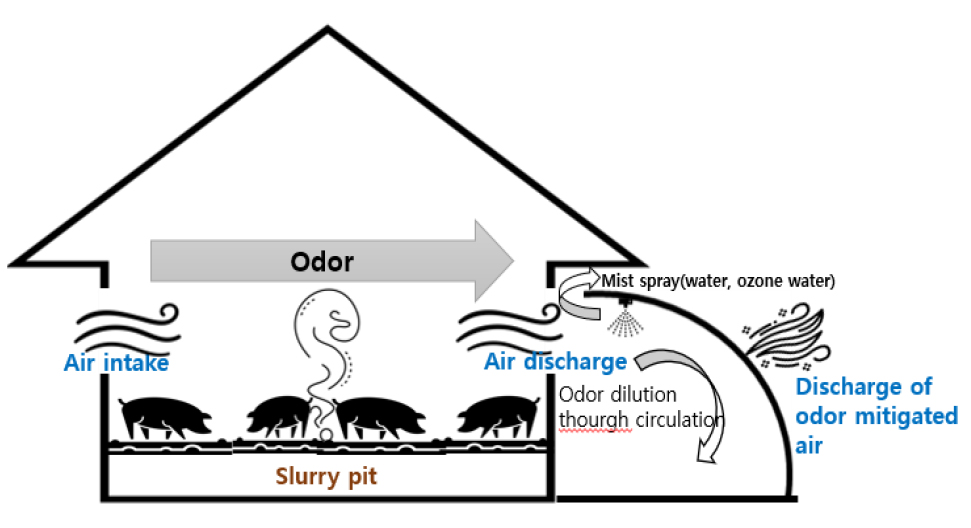
Figure 1.
Diagram of bio-curtain.
2. 안개 분무 시스템
가장 보편적으로 활용되고 있는 악취 저감 시설 중 하나이다. 안개 분무 시스템은 노즐을 통해 물, 화학약품 (악취저감용, 소독용 등), 미생물제재 등을 미세한 입자로 분사해 축사 내 분진, 악취물질 (NH3 등) 등을 제거하고, 나아가 온·습도를 조절해주는 역할도 수행하는 시설로서 Figure 2와 같은 형태로 나타낼 수 있다.
특히, 초미세 입자로 분사 시 순간적으로 증발·냉각되면서 주변의 분진 및 악취 물질을 흡착 제거할 수 있으며, 여름철 축사 내 냉각 효과로 가축들의 더위 스트레스를 저감시켜 줄 수 있다. 또한, 업체마다 차이는 있지만 최근에는 대부분 자동화 시스템을 적용하여 특정 조건 (시간, 온도, 습도 등)별로 자동 운전 설정이 가능하기 때문에 운영이 간편하다는 장점이 있다.
안개 분무 시스템 설치 시, 분사거리, 분사각도, 분사량, 노즐 간격 등을 고려하여 축사 내부에 전체적으로 골고루 분사가 이루어 질 수 있도록 설계를 해야한다. 운영 시 주의 사항으로는 분무량이 과다할 경우 축사 내 습도가 너무 높아지거나 폐수가 다량 발생할 수 있으므로 정기적으로 분무량을 점검하며 조절해 줄 필요가 있으며, 노즐의 막힘 현상 또는 온도가 낮은 겨울철에는 노즐이 동파방지를 위해 주기적인 관리가 필요하다.
설치 비용은 양돈농가 1,000두 규모 기준으로 약 20백만원 정도가 소요되며 (배관, 노즐, 모터 등 포함), 다른 악취 저감 시설들에 비해 설치가 간편하고, 소요비용이 저렴한 편이기 때문에 많은 축산 농가에서 활용하고 있는 시설이다.
악취 저감 효율은 다른 악취 저감 시설들에 비해 다소 미비하지만 분진 제거 효과는 우수한 것으로 알려져 있다.
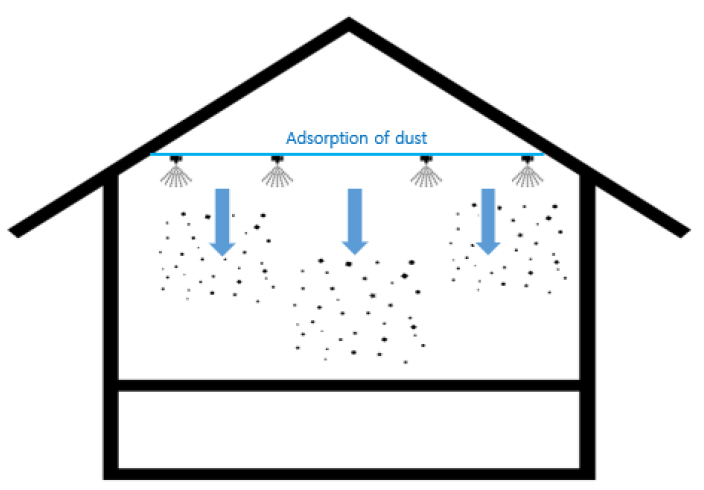
Figure 2.
Diagram of mist-spray system.
3. 액비순환시스템
액비순환시스템은 돈사에서 배출된 슬러리를 액비화시설에서 액비화하여 다시 돈사 내 피트로 순환시키는 것을 반복하는 시스템으로, 돈사 내 악취저감, 내부 온 ·습도 유지 등의 효과를 통해 사육환경을 개선시켜주는 시스템이다.
본 시설은 농장 및 업체마다 시공 방식이 다양하지만 가장 보편적인 공정흐름은 Figure 3과 같이 돈사 분뇨 (슬러리)배출→원수조→고액분리→액비화시설 (폭기조 및 침전조)→순환조→돈사다.
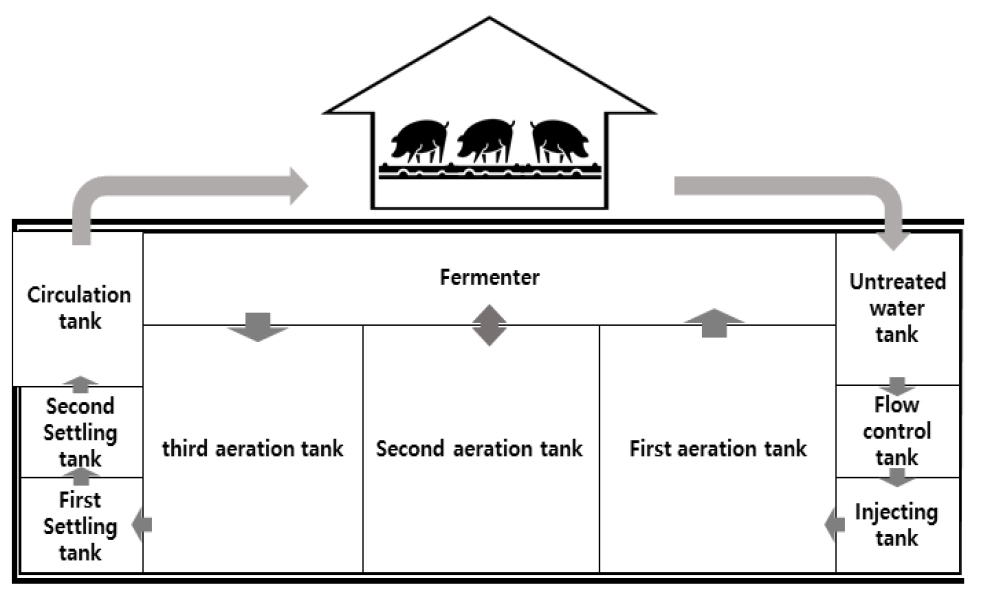
Figure 3.
Diagram of pit recharge system.
액비순환시스템의 가장 큰 장점으로는 돈사내 슬러리 부패 방지에 의해 악취 및 유해가스 저감으로 돈사 내 사육환경 개선 (폐사율 저감, 사육일수 감소 등) 및 농가 생산성을 향상시키고, 돈사 내부 온도 유지에 도움 (30∼35°C로 유지된 액비가 피트로 지속 유입), 퇴비화 시설을 갖추고 있지 않아도 되는 이점 등이 있으며, 단점으로는 높은 초기 투자비용, 돈사 및 슬러리 소독제 사용 불가, 운영 및 관리 방법의 어려움, 농가별 적용 방식의 편차 등이 있다 (Ministry of Environment, 2006).
필수 설치 시설로는 슬러리 피트, 집수조, 폭기조 등이 있으며 필요에 따라 고액분리장치, 침전조, 정화방류처리시설 등의 설치가 필요하다. 운영 시에는 농가마다 차이가 크지만, 운영관리가 농가들의 사례를 살펴보면 공통적으로 초기 미생물의 안정화를 위해서 180일 이상이 소요되었으며, 슬러리의 폭기조 내 저류 기간을 30~40일 정도로 운영하고 있었다. 또한, 폭기조 내 온도를 30°C 내외로, MLSS (mixed liquor suspended solid)를 3,000~4,000 ppm 수준으로 운영하고 있었다.
설치 비용은 양돈농가 1,000두 규모 기준으로 약 90~100백만원 정도가 소요되며 (배관, 폭기조, 폭기장치 등 포함), 운영비는 전기세 (40만원/월) 및 미생물제 투입비용 등이 소요된다.
악취 저감 효율은 돈사 내부와 배출구 및 부지경계선에서의 공기 중 암모니아와 황화수소 농도는 액비순환시스템 적용으로 50% 이상의 저감 효과가 나타났으며, 메틸머캅탄과 트리메틸아민 역시 비교적 낮은 수준으로 조사되었다는 연구 결과가 있었다 (Kim, 2015).
4. 습식 세정탑
통상 ‘(습식)스크러버’, ‘습식집진기’라고도 한다. 세정수를 순환하여 공기 중에 있는 분진과 악취물질을 제거한 후 배출하는 시설이며 (NIAS, 2017), 함진가스에 세정액을 분사시키거나 세정액에 함진가스를 분산시킬 때 생성되는 액적, 액막, 기포 등에 의해서 배기가스에 함유된 분진을 분리, 포집시키는 시설로서 Figure 4와 같은 형태로 나타낼 수 있다. 분진은 물론 공기 중에 포함되어 있는 악취의 입자를 분리시켜 효율적으로 제거하는 역할도 가능하므로 다양한 사업에서 사용되고 있다 (Chung, 2017).
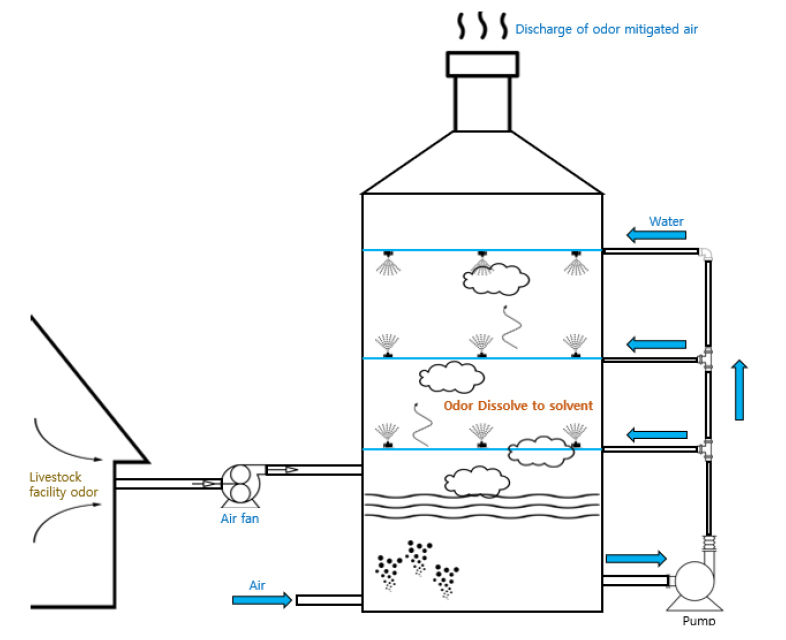
Figure 4.
Diagram of scrubber.
스크러버를 통과하는 공기와 세정액과의 접촉면적을 증가시키기 위해 충진재를 사용하며, 세정액으로 물, 액비, 약액 (황산, 수산화나트륨), 목초액 등을 사용할 수 있다. 세정액으로 약액과 같은 화학약품을 사용했을 때에는 2차적으로 폐수처리를 해주어야 한다.
시설 가동 시 소음으로 인한 민원이 발생할 수 있으므로 설치 시 민가와의 거리를 고려할 필요가 있다. 운영 시 처리효율을 높이기 위해 세정액 상태 등을 고려하여 주기적으로 세정액 및 중진재의 교체가 필요하며 (충진재는 종류에 따라 재활용이 가능한 경우도 있음), 겨울철 동파 위험이 있으므로 관리에 주의할 필요가 있다.
시설 설치 비용은 저렴한 편이나 수도세, 약품비, 전기세, 폐수처리비 그리고 충진재 교체비용 등 운영 비용이 다른 악취 저감 시설들에 비해 많이 소요된다.
악취 저감 효율은 충진재식 스크러버에서 90%이상의 암모니아 (NH3) 제거 효율을 나타냈다 (pH 3의 조건에서)는 연구 결과가 있었다 (Han et al., 2007).
5. 기타
(1) 바이오필터
바이오필터는 생물학적 방법으로 축사 배기구로 배출되는 공기 내 악취 물질들을 저감하는 시설로써, 악취 저감용 미생물을 다공성 담체에 고정하여 미생물의 대사활동으로 인해 통과하는 공기 내 악취 물질들이 저감될 수 있도록 하는 시설로서 Figure 5와 같은 형태로 나타낼 수 있다. 악취 물질과 휘발성 유기화합물들을 미생물의 분해작용에 의해 무취한 이산화탄소나 물로 분해시켜 주어 저농도 악취제거에 효과적이다 (Ministry of Environment, 2012).
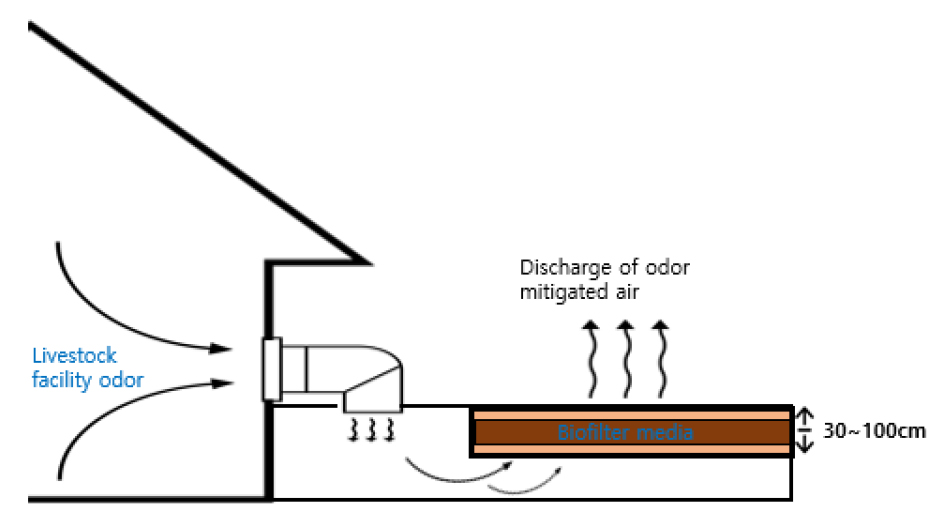
Figure 5.
Diagram of bio-filter.
바이오필터는 일반적으로 축사 측면 및 피트 배기구에 설치하며, 다공성 담체에는 미생물들이 살아갈 수 있는 환경인 충진재 (볏짚, 톱밥, 왕겨, 바이오차, 우드칩 등)를 채워 주도록 설계한다. 미생물을 활용해 악취를 제거한다는 점에서 친환경적이라는 장점이 있다.
설치 시 배기구 1대당 1기씩 설치하며, 공기의 충진재 통과 시간은 5초 이상이 되도록 설계한다. 운영 시 분진이 많이 발생하는 축사의 경우 바이오필터 충진재에 배출 공기가 들어가기 전 물을 분사해 주어 분진을 줄여주면 효율이 증진된다. 또한, 주기적인 충진재 교체가 필요하며, 물, 액비, 목초액 등을 이용해 충진재 내 습도 유지를 해 줄 필요가 있다.
자체 제작이 가능하기 때문에 설치 비용은 유동적이다. 일례로 가변형 (우드칩 충진)일 경우 1기당 100만원 정도의 설치 비용이 소요되며, 충진재인 우드칩은 m3당 5,000원 정도의 비용이 소요된다.
악취 저감 효율은 바이오필터 설치 전, 후 밀폐형 퇴비화 시설의 악취 저감 효과를 비교한 연구에서 시설 운영 전 암모니아, 황화수소 발생량이 각각 83 ppm, 15 ppb에서 시설 운영 후 각각 8 ppm, 1 ppb 수준으로 감소, 즉, 암모니아 90.1%, 황화수소 99.4%의 저감 효과가 있다는 연구 결과가 있었다 (Song, 2006).
(2) 흡착 탈취 시설
흡착 탈취 시설은 고품질의 측수 탈취제를 사용하고 그 구조가 다른 시설들에 비해 단순하다는 특징이 있다. 또한 2차 공해가 없다는 점과 동파 우려가 없다는 점이 큰 장점이다. 하지만 충전 여재의 교체 주기가 짧고 재활용이 불가능하다는 점과 다량의 흡착 폐기물일 발생한다는 단점이 있다. 설치 비용은 다소 많이 소요되지만, 90% 이상의 악취 저감 효율을 보여준다.
(3) 활성탄 흡착 탈취 시설
활성탄 흡착 시설은 흡착제로 ‘활성탄‘을 사용한다는 특징이 있으며, 활성탄 종류에 따라 대상 악취 물질의 효과가 각기 다르다는 특징이 있으며 Figure 6과 같은 형태로 나타낼 수 있다. 물, 약품 등을 사용하지 않는다는 점과 설치 구조가 단순하다는 장점이 있지만, 주기적인 활성탄 교체가 필요한 점 (폐기 활성탄 발생)과 배기팬에 역압 발생 우려가 있다는 단점이 있다.
설치 비용은 비교적 저렴한 편이지만, 활성탄 교체비의 경우 악취물질 농도가 높을수록 비용이 증가할 수가 있다. 악취 저감 효율은 80% 이상의 효율을 보여준다.
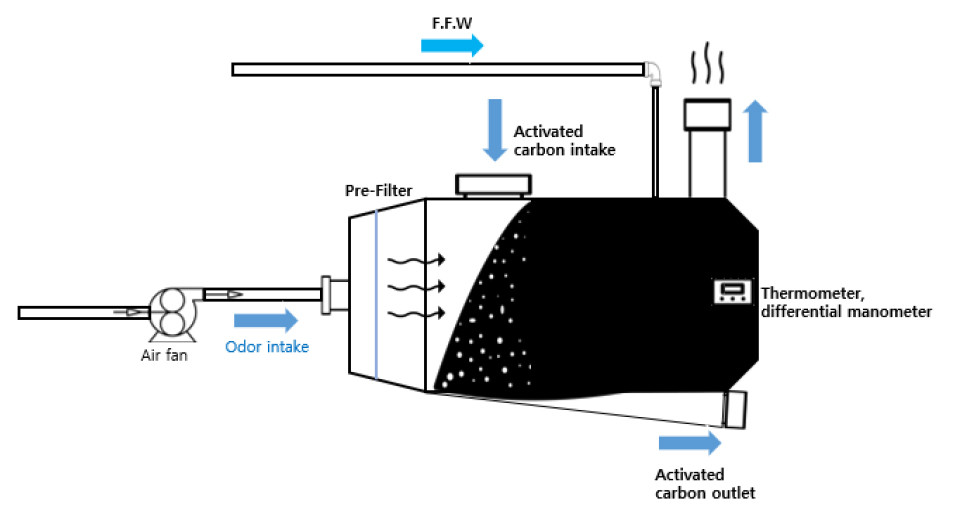
Figure 6.
Diagram of activated carbon absorption facility for odor.
(4) 바이오필터 연계 바이오트리클링 (우드칩) 시설
바이오필터 연계 바이오트리클링 (우드칩) 시설은 세정액으로 물, 액비, 목초액 등을 사용한다는 특징이 있으며 Figure 7과 같은 형태로 나타낼 수 있다. 세정 탈취 및 생물 탈취방식으로 탈취 효율이 우수하다는 점, 수분 조절 여수액이 재사용 가능하다는 점, 분산 설치가 가능하여 개체별 탈취효율이 우수하다는 점 그리고 인위적 관리가 불필요하다는 점 등의 장점이 있다. 하지만 운영 시 적정 함수율을 유지할 필요가 있고, 미생물의 배양기간이 필요하며, 배기팬에 역압 발생 우려가 있다는 단점이 있다.
설치 비용은 그다지 비싸지 않으며, 분산 설치를 통해 가동경비 최소화가 가능하다. 악취 저감 효율은 90% 이상의 효율을 보여준다.
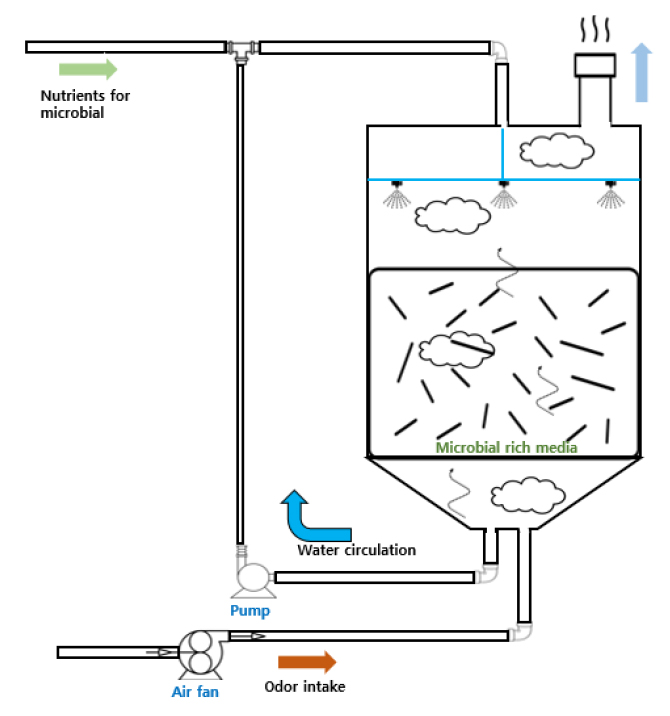
Figure 7.
Diagram of bio-trickling system linked to bio-filter (woodchip-base).
(5) 미생물제재
미생물 제재의 경우 사료첨가제와 축사내외에 살포하는 제재로 나눌 수 있다. 사료첨가제의 경우 체내에 있는 암모니아 전환 효소의 작용을 미생물을 통하여 억제함으로써 축분내 암모니아 발생을 줄여 악취를 저감하는 것이고, 축사내외에 살포하는 제재의 경우는 악취물질의 원인인 탄소, 질소, 황화합물을 미생물이 먹이로 사용하여 악취를 저감하는 것으로 Figure 8로 나타낼 수 있다.
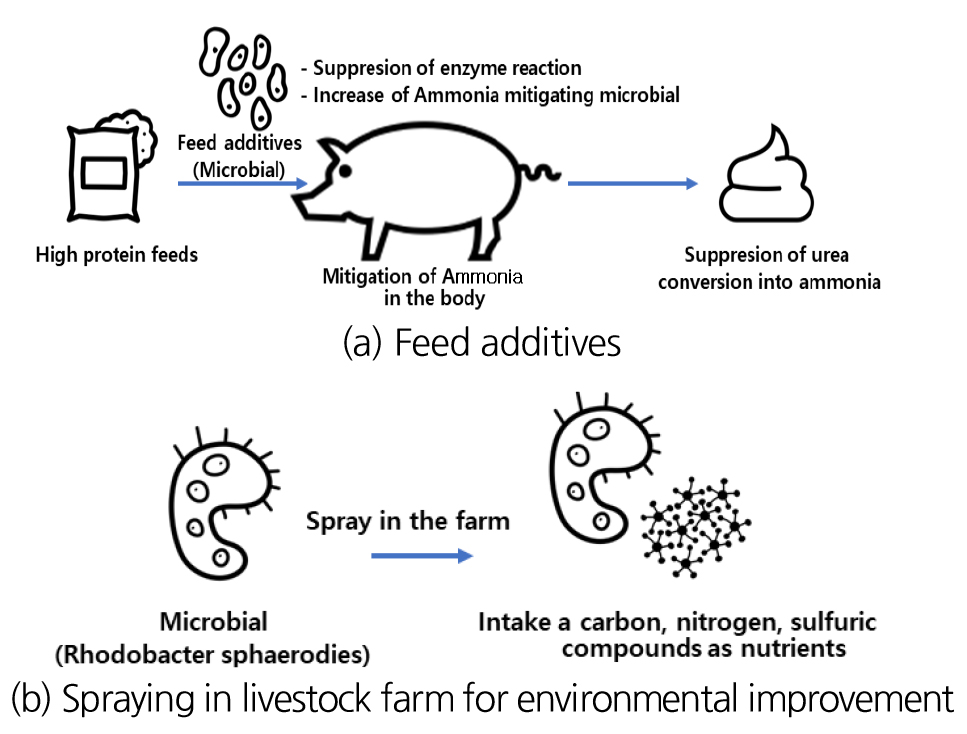
Figure 8.
Use of microbial.
결 론
현재 우리나라의 축산업은 2018년 기준 농촌경제연구원 자료에 따르면 농림업 생산액의 38.3%, 18조9580억 원을 차지할 만큼 급격하게 성장해왔다. 하지만 양적인 경제규모로 성장해온 나머지 환경문제에 대한 관심이 부족하였고, 이로 인한 축산시설에서 발생하는 악취로 인해 민원이 지속적으로 증가하고 있는 추세이다. 축산시설에서 발생하는 민원 등을 해결하기 위해 2015년 환경부에 지자체 사육 조례 제·개정 관련 권고안을 발표 하였고, 2017년 현황조사 결과를 살펴보면, 155개 기초자치단체 중 151개 약 97.4%가 제정하여 운영하는 것으로 2015년 (155개 중 144개) 조사된 결과에 비해 7%이상 높아진 결과로 대부분의 기초자치단체에서 축사사육제한구역이 설정된 것으로 볼 수 있었다. 전국 지자체 조례의 가축사육제한 평균 거리를 살펴보면 한육우 241 m, 젖소 321 m, 돼지 971 m, 가금류 785 m 등으로 파악되었으며, 지자체별로 상이한 거리제한을 두고 있다. 지자체 사육 조례 제·개정 관련 권고안 비고 내용에는 ‘동 권고안은 신규 입지하는 시설 및 허가를 받거나 신고한 기존시설의 증·개축을 관리하기 위함’, 악취를 저감할 수 있는 시설 설치 및 관리하는 경우 축산 신축 및 증·개축시 거리 제한 완화 가능의 내용이 수립되어 있으나 151개 지자체가 비고 내용에 따른 완화 조항은 수립되어 있지 않았다. 축산시설에 대한 제재만을 서둘러 실시했다고 볼 수밖에 없을 것이다. 2016년에서 2017년에 걸쳐 농림축산식품부는 광역축산악취개선사업을 통해서 축산농가에 악취저감시설을 설치하여 모니터링해본 결과 암모니아 (NH3)가스의 저감을 확인할 수 있었다. 시설유형별로는 바이오커튼 53.9%, 안개분무시설 34.9%, 액비순환시스템 79.9%, 탈취탑 40%의 저감효과가 나타나므로 축산시설에서 발생하는 악취원인에 따른 조사와 그에 따른 저감시설 설치 방안을 마련하여 가축사육거리구역 지자체 조례 권고 (안)을 개정하는데 중요한 참고자료가 될 것으로 기대한다.
축산시설과 관련된 악취발생원인에 따른 해결방안은 Table 23과 같이 해결 할 수 있다.
따라서, 가축사육거리제한에 따른 권고 (안)에 대해서 악취저감시설의 효과 규명을 통해 악취저감시설 설치에 따른 완화조건을 반영하여 지자체별로 설정되어 있는 가축사육거리제한 기준에 대한 재산정이 필요할 것이라고 여겨진다.
Table 23.
Solution for each cause of odor in Livestock facilities.
|
Place
|
Cause
|
Solution
|
Needed equipment
|
Live
stock
farm
|
- Odor in livestock facility (watering facility,
feed container, corridor, ceiling etc)
- odor diffusion from shipment of livestock
- manure recovery facility ( in case of
operating a rotary facility or transporting
a manure
- liquid manure recovery facility: in case
of operating a aeration facility or putting
a unprocessed slurry manure or
transporting of unstable liquid manure
-neglected management of manure
around livestock facility
- neglected management of animal carcass
-anaerobic status of pig manure slurry
sediment
- livestock feeding unfitting for standard
feeding criteria of feed
- unfrequent use of composting
amendment
|
- frequent use of microbial
- keeping a livestock barn clean
- confinement of livestock barn and
transporting vehicle
- confinement of manure recovery
facility and transporting vehicle
- confinement of liquid manure
recovery facility
- installation of animal carcass
disposal machine
-introduction of animal carcass
disposal project
- removal of pig manure slurry
sediment in livestock facility and
liquid manure storage
-livestock feeding suited for standard
feeding criteria
- use of composting amendment
- keeping a spare capacity of slurry pit
over 30 cm
|
- pit recharge system
- bio-curtain, filter
- a microbial
- Animal carcass disposal machine
-removal of pig manure slurry
sediment in slurry pit or storage
-comprehensive confinement of
livestock facility (transporting
vehicle, manure ․ liquid
manure recovery facility etc)
|
Resource
recovery
Facility
|
-manure recovery facility (in case of
operating a rotary facility or transporting
a manure
- liquid manure recovery facility (in case
of operating a aeration facility or putting
a unprocessed slurry manure or
transporting of unstable liquid manure
-in case of mixed recovery of livestock
manure and food waste (negligence
management or drying of food waste
|
-confinement of manure.liquid
manure recovery facility
|
- installation of scrubber
- bio-curtain
- comprehensive confinement of
livestock facility (transporting
vehicle, manure ․ liquid manure
recovery facility etc)
|
|
Farmland
|
-application of unstable manure and
liquid manure
-no ploughing after application of
fermented manure and liquid manure
in croplands
-over-application of fermented manure
and liquid manure in croplands
- neglect of fermented manure and
liquid manure in croplands
|
- application of stable manure and
liquid manure in cropland
- supply of compost maturity
measurement machine
- application following standard
application criteria of fertilizer to
cropland
-promoting a odor management
method after manure application
|
- mandatory test of livestock
manure by compost maturity
measurement machine
- preparation of cropland
manure application protocol
|